| Contents | Foreword | 1 | 2 | 3 | 4 | 5 | Life on Kuala Kangsar, Upper Perak |
7 | 8 | 9 | 10 | 11 | 12 | 13 | 14 | 15 | 16 | 17 | 18 | 19 |
The ferry took me across to mainland Butterworth, where I took the air-conditioned train of FMS Railway. Two hours to Kuala Kangsar did little to console me for the sudden uprooting from the near-Paradise of Penang. Kuala Kangsar started off at a serious disadvantage in such circumstances, and my first day there did nothing to overcome my prejudice. Penang had spoiled me.
A small thickset man in white shorts and a soft grey felt hat was waiting for me on the platform. He was my new chief, a gruff tough Australian called Horsley. Lest he be misjudged at the outset, let me put the record straight. He was a great guy, hardworking, efficient, and soft hearted under the tough exterior; but I had to mature before I found that out.
We drove in Horsley's car down a hill to the crossroads where the Sultan of Perak and residents had provided a granolithic clocktower to commemorate the coronation of King George VI, over a bridge and up to Government Hill, once the scene of battle during British colonization, but now a golf course and residential area for Government officers. On the right a Government building stood high above terraced lawns, its long steep flight of steps marked with the levels and dates of many disastrous floods which had inundated the town when the River Perak had been swollen by tropical rains. Horsley explained that the river had risen unchecked before the Chenderoh Dam had been built upstream by the Perak Hydro-Electric Company. Stately palms formed an avenue to the Government Officers' quarters. Horsley's house stood in a compound ablaze with colour and surrounded by neat lawns. The house was of recent design, with solid brick walls and red tiled roof. Horsley did not like the house. It heated up uncomfortably by day, and the glass windows did not compare with the open walls and chick blinds of the older houses. As we ate lunch brought in by a fat smiling Chinese cook-boy. Horsley told me that he was a bachelor, the house was too big for him, and he was going to build a house to his own design when he retired to Australia.
As we left for the office I broached the subject of accommodation for myself. Horsley told me that the Assistant Engineer's bungalow still held the effects of my predecessor, who had been transferred temporarily to Ipoh to supervise military works. In any case there was no need for me to have been sent to Kuala Kangsar, growled Horsley; he was managing quite well on his own.
At the office I was told to sit opposite my new chief at his desk, and there I sat throughout the sultry afternoon whilst he telephoned dozens of people and interviewed a legion of Tamil clerks and overseers. Then Horsley's cook-boy came in, bringing with him a slim, smiling Chinese who had apparently heard of my arrival and had travelled thirty miles to apply for the post of cook-boy. Horsley read the testimonials - he did not hand them to me - remarked that they could be purchased cheaply from petition-writers anyway, and scrutinized the applicant carefully. A few words were exchanged in Malay, escaping my comprehension, and Horsley then informed me that I had appointed the lad and was to pay him thirty dollars a month. The humid heat, bewilderment and demoralization left me without words even to murmur a thanks.
A telephone conversation with the Assistant Engineer at Ipoh fixed up the matter of his quarters, and as the evening approached I entered my new home. It was a wooden bungalow with red tiled roof, standing on stone pillars some four feet high. The front wall was louvred to a height of three feet, and the rest was merely expanded metal. The overall effect was that of a cricket pavilion. The eaves overhung the walls some three feet, making the interior shady, even dark. There were no gutters edging the roof; instead there was a deep and wide concrete channel around the building, so that rainwater would run straight off the roof and into the channel. The house was painted black and white outside and cream inside. The polished hardwood floor drummed noisily at every step. The accommodation was simple; a large lounge, a single bedroom, a bathroom, and a dining space. The dining area was at the rear of the bungalow, and a covered way communicated with the kitchen and servants' quarters. As I inspected the quarters I met my sais Hussein, and his beautiful young wife, who had followed me from Penang in my car. With the self-centred introspection of youth I had never given them a thought as I brooded over my own problems. As for the new cook-boy, he was quietly working miracles. That evening I had an excellent meal, though none of my household things had yet arrived. My bed had acquired a mosquito net and linen, and all was spick and span. Most of the furniture was Government issue anyway. The boy's name was Ah Chang, his wife Ah Fong and daughter Ah Lin, and their new baby as yet unnamed. They were joining him later. The servants had all been fixed up with bed mats and bolsters from Horsley's household. No fuss, no complications. All was well, without any help from me.
Next day a lorry brought my luggage - barang - from the station, and Hussein drove the black Chevrolet from the railtruck. After a good grumble at the dusty and finger-marked condition in which he found it, he set to work cleaning it with meticulous care. We were ready for work.
* * * * * * * * * * * * * * *
There were not a great number of Europeans in Kuala Kangsar, and the only way to meet them was to join the Club. My faltering Malay was inadequate for me to converse freely with my servants, who spoke no English. My near neighbours ignored me; an attack of dengue fever laid me low for a couple of days, and the local Doctor, a Scot called Braine, ticked me off for dosing myself with quinine tablets. Horsley seemed to have a down on me. Then the local Police Superintendent and his wife took pity on me, and an invitation to dinner one night launched me into the small social circle of the district. At the dinner I met the District Officer and his wife, a popular couple, and he proved a most valuable friend in the days that were to come.
One afternoon when we were able to leave the office at a reasonable time, Horsley took me to the Istana - the Sultan's Palace - for tennis. The Istana was modern, and combined Eastern design with latest methods and materials. Its huge granolithic mass stood on the rise of a hill overlooking the River Perak. The large central dome and four corner domes were covered with mosaic tiles of mixed colours, which shone like speckled gold in the midday sun. Brilliant red and yellow flowers around the walls made the immaculate lawns look like brightly fringed Oriental rugs. Palms and gaily blossomed bushes and trees were dotted about the lawns, creating an atmosphere for fairy tales with sugar-loaf castles and magic carpets. Twice a week the Europeans were guests of the Sultan of Perak, a keen tennis player. Horsley introduced me to the Sultan and to the Rajah di Hilir. Both were most charming and obviously highly educated men. The Sultan was a witty conversationalist and a good tennis player, and the Rajah was a great sport who enjoyed the lob and the resulting behaviour of his harassed opponent.
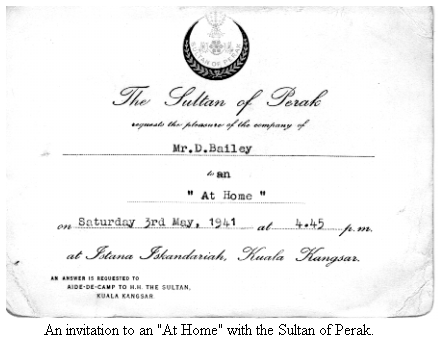
After the game we used to linger at the courts - which were hard courts made from the chewed material of anthills - and we sipped passion fruit juice as we watched the sun go down, which it did very quickly at the same time every day. The muezzin would call out the stirring summons to prayer from the Istana's private mosque, and the cry would be echoed by another voice from the minaret of another mosque nearby. The tropical sky was beautiful beyond description at this time of day. Over to the west and the forest-clad hills with a ruined Istana called The Hermitage, the sky was pale turquoise, and as one turned further west the colour deepened until the sky was pure ultramarine, whilst thin stray wisps of cloud gleamed and shone with silver, pink and gold as they moved slowly like fairy feathers across the setting sun. Two hundred times or more this ritual of light and colour and infinite beauty was performed for my wonder and delight. And those tennis parties worked their charms on me and helped me become part of Kuala Kangsar.
The process of settling down as Assistant Engineer Kuala Kangsar was slow, but eventually my neighbours came to accept me - or did I respond to them? - and the house and garden began to interest me. Soon I was turning over flower beds and planting vegetables. One morning as I was working in the garden, a group of small Tamil boys apppeared at the entrance to my compound. They were apparently interested in a small fruit tree in a corner of the compound, which bore fruit of a kind not eaten by Europeans. They were delighted when I reached up and picked some of the fruit for them, and a new friendship started that day.
The ringleader of this group was a fourteen-year old named Avuly, a bright and intelligent lad with a good knowledge of Malay. We talked about flowers and vegetables which were growing in the compound, and he was very knowledgeable about gardening. Soon he was telling me the Tamil names for the vegetables, and the boys squatted near me, weeding round the flower beds.
The visits became regular, and small gifts such as tomato seedlings or a papaya arrived from time to time. This innate goodheartedness made me search for a way to reciprocate; then came the idea of stamp collecting. An hour spent one day floating stamps off letters from home produced a good selection, from halfpenny to half crown, and on the next visit I handed them round. The boys identified King George VI, and I told them to keep stamps in an album so that I could add to their collection.
Avuly was an expert tree climber, and one day he climbed my coconut trees to twist off the fruit. He stripped off and clambered up the tree, gripping the rough trunk with his feet, sliding his hands up, then pulling his feet up until his knees were level with his shoulders, stretching and folding with smooth rhythm and great speed until he disappeared in the fronds. Ripe coconuts then came crashing down to the delight of the other boys. With my permission the boys then gathered the crop from my mango tree, using the method used by boys at home when the conkers are ripe - sticks thrown with great accuracy to bring down a shower of fruit.
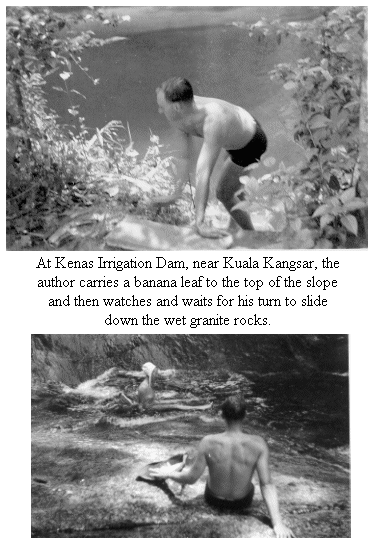
Sundays were the popular days for the boys to visit and for visits to Taiping Swimming Club and swimming parties at Mengle Enchor, where the overflow from the Waterworks reservoir ran down a granite slope to a deep pothole. We slid down the slope on banana leaves. On the walk through the woods to that spot we had to watch out for leeches, which dropped from the trees and fastened themselves on the swimmer's bare torso. A smouldering cigarette end was the device used to make them let go. Another good bathing pool was the Irrigation Dam on the Kenas Road. Visits to these places were followed by tiffin and drinks at one home or another, and my job was to help provide transport.
One Sunday I abandoned caution, and had some of the swimmers to tiffin in my bachelor home. My cook-boy Ah Chang smiled as I fussed and fiddled with detail - he had had service with married couples previously, and knew the ropes. Came the day, and guests were The Health Officer and his wife, and the young Police Officer and his wife. We went to Taiping to swim, returning with great appetites, though mine was perhaps inhibited by apprehension. The curry was prepared by my sais's young wife on true Malay lines, with bowls of curried lamb, curried fish, curried chicken, prawns, curried vegetables, and the sambals - salted nuts and dried fish, shredded white onions, shredded fresh coconut, crisps, sweet chutney and sliced banana. The sweet was a sago mould topped with coconut milk and Gula Malacca - a toffee-like syrup extracted from the flower of the palm. At three o'clock we went our different drowsy ways for the luxury of a lie-off. My small team of servants had worked wonders.
So Penang became a memory and Kuala Kangsar was home. In fact Kuala Kangsar was representative of the real Malaya, a small community in the heart of the country. Penang was more cosmopolitan in its small way, no doubt influenced by its function as a port of call on the trade routes. Very quickly my Malay developed - when one is part of the population which speaks a language other than English, even an Englishman has to make an effort - and in fact it became fun. My flat north-country vowel sounds were very similar to the Malay vowels. Soon the rather higher class Malay of the Sultan and his household - the Rajah Malay - began to interest me. Furthermore, as there were Chinese and Indians who spoke in their own tongues to each other, my interest was aroused. Occasionally I visited the small local cinema to see Indian and Javanese films. Even in those early days their technique was impressive, and some of the actors were supremely artistic. The East was getting under my skin.
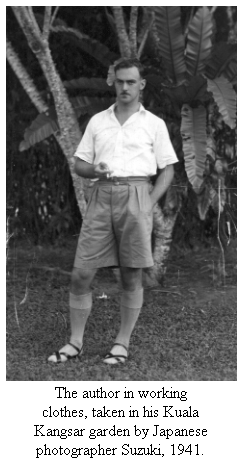
One day a Japanese photographer called Suzuki called with his son, and took my photograph for the family album. He was probably taking a lot of other photographs also. He had a shop in town - but not for long.
The European Club was a bore. There were American and English magazines to read, a bar and a radio. The doctors and Malay School Teachers were there, as well as the Police, engineers, civil service officers and nurses. And the rubber planters. Horsley was in the Club one evening and he made a comment as a party of planters invaded the bar. "When the slump was on", he said "the planters grumbled at the security of the Government Officer. Now they're in a boom, we're small fry."
The Clubhouse was of the usual open-walled construction - the design reminded me of a cricket pavilion - and the main room, used as a ballroom, was open to view from the road. When we were having a social evening or dance, our activities were always watched by twenty or thirty Asiatics, dressed in white, who stood along the roadside in the black night. It was eerie; the silent watchers feeding on the spectacle of white men and women drinking and smoking, dancing to the music of a radiogram, laughing and sometimes fooling about. The others ignored the watching figures, but I found the experience unnerving. It was as if we were marionettes performing for their benefit. When a man became rowdy or worse off for drink it must have been vastly amusing to them - or was it? What was their opinion of us when that happened? That seemed important to me at the time, because the District Officer, the Police Officers, the Medical Officer - all the Colonial Officers running Kuala Kangsar - met at the Club, and were on view. It still seems important to me today.
As time passed, and my friendships settled into a pattern, it was possible to ease away from the often uncomfortable atmosphere of the Club, where there was obviously an incompatible mix of age groups and social behaviour. The swimming and tennis-playing types tended to stick together. At the Malay School I learned to play squash also, and it was great to get into a muck sweat in the heat of the tropics, then to shower off and sit in a huge bath sheet - made by prisoners in the local jails - sipping passion fruit juice, and talking shop. Because that is what we all seemed to do mostly - talk about our work, and what we were going to do when we went home on leave or at the end of the tour of duty. The British did not seem to me to put down roots; the job was merely a means to an end, a way to make a good living with a good pension or gratuity at the end of it. Horsley was already thinking of his retirement to a house of his own design, and he was early middle-aged. At one time I found myself working out a plan for when I retired at 45. Those highly qualified and well educated Colonial Servants seemed incapable of regarding Malaya as their home. As for their children, by the time they were eight years old they were sent to school in England or Australia, and their parents were simply the providers. All the exotic scenery, the dreamy evening skies, the rich colour and lush vegetation, the luxury of personal servants on 24-hour call, all that would be discarded at the end of a career. That couldn't be right.
| Contents | Foreword | 1 | 2 | 3 | 4 | 5 | Life on Kuala Kangsar, Upper Perak | 7 | 8 | 9 | 10 | 11 | 12 | 13 | 14 | 15 | 16 | 17 | 18 | 19 |