On the twenty-fifth of September 1916 a German Zeppelin airship flew over Lancashire, dropped three bombs which killed thirteen people in Bolton, then flew across to Colne, having jettisoned its remaining bombs on the way. This was late at night, and probably not many people saw the airship or even heard it. Almost certainly my mother didn't witness this exciting innovation in the 'War to end Wars'. In any case, she had other things to think about. She had that day given birth to her fourth child - me.
Dad was a master craftsman - so-called because he had his own building business - and the fact was important enough to be recorded on my Birth Certificate. In a surge of patriotism aroused by the recruiting campaign started by the Earl of Derby in January 1915, he and many other Colne men had volunteered. I believe Dad was based at Catterick Camp, and he was in the new-fangled Flying Corps. His craft training was obviously an advantage, because he was put to work on airframes, stretching canvas over wooden frames and soaking it with 'dope' - a cellulose liquid with the smell of peardrops. Dad hated that sickly sweet smell, and many years later he reacted strongly when my sisters used nail varnish made with the stuff. No doubt he had no wish to be reminded of the war which seemed to settle nothing.
The Zeppelin airship represented something entirely novel as a concept of warfare. In fact aircraft were very much in their infancy, and in the 1914-1918 war they were initially used for reconnaissance over enemy lines, in support of ground forces. When aerial combat was first introduced, the only weapons were hand guns. The pilots probably were most at risk when they took off or landed in their rickety machines.
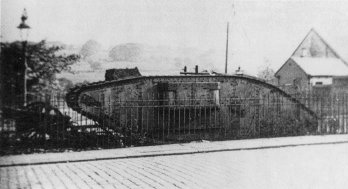 During the War we lived in one of the houses my father had built, and he left a couple more unfinished, to be completed when the War was over. Colne was denuded of men, and the town's energy was sapped by its War efforts. As a tribute to the town's contribution to victory, a 28 ton tank was presented to the Council in November 1919. It rumbled up the main street to the top of the hill, to be handed over at the Town Hall, then was driven to a prepared site at Hyde Park, to rust away over the years. I remember that green-painted tank, and recall the day when its remains were cut up and taken for scrap. Hyde Park, by the way, wasn't a park at all, merely a paved triangular island between three roads, with a telephone box, a few seats and two or three small trees - and that ghastly tank to remind the War widows, and desolated girl friends, of the War that was intended to make the world fit for heroes to live in.
The victorious Allies imposed the Treaty of Versailles on Germany, and banned the manufacture of armaments by their old enemy. And in 1919 a young Shropshire lady and the Miners' Federation started the Save the Children organisation to help the young Austrian children who had been victims of the Allied blockade, and thereafter many children in the Balkans; all children of the War.
Dad restarted his business, but the first postwar prosperity gave way to twenty years of trade depression and massive unemployment. A vivid memory of my early schooldays was eleven o'clock each 11th of November. The apparently interminable two minutes of dead silence as we stood in Lord Street School Assembly Hall was broken by the sobs of the spinster teachers. As far as I can remember, all the lady teachers at the School were spinsters.
Colne is a small town of pre-Roman origin, sitting on a hill in the Forest of Pendle. Its history is interesting, containing all the elements of achievement, strife, music, religious turmoil, humour and rugged character to supply the inspiration for countless works of literature and drama. Its surrounding countryside is a joy to explore, steeped in folklore, ancient history and witchcraft. Rough farmland, moorland, stonebuilt hamlets and winding stonewalled roads, with a generous sprinkling of old inns, await the visitor. For many years the town relied on the woollen and cotton trade, and huge mills occupied the north and south valleys. As children we seldom saw the stars at night, because the smoke from the mill chimneys maintained a permanent pall over the town. We saw blue starlit skies only when we went away on holiday; if we were lucky the smoke might clear away during the Wakes weeks when the mill boilers were shut down. Colne is now a smokeless zone, and the blackened stone buildings have been scrubbed clean.
During the postwar years of depression, time seemed to stand still for the war babies - and indeed for the town. The Infants and Primary School which we attended is still full of children, little changed since 1916. The parents crowd the surrounding streets nowadays with their cars as they deliver or collect their smartly accoutred children, otherwise the scene is much as it was. The main street still retains many of its old buildings, such as the Co-op, a magnificent, stately pile which was a shopping complex ahead of its time, with a large restaurant and ballroom and shops as varied as a latter day out-of-town hypermarket. One of my sisters learned the trade of tailoress in the bespoke Tailoring department there. The 19th Century Town Hall and clock tower still stands at the top of the hill, and nearby is the 12th century Parish Church. But the sett paved road and the tram lines have gone, replaced by ubiquitous tarmacadam. There are still many fine villas along the main street, and down the side streets which fall steeply to north and south are terraces of large stonebuilt houses, most of them with back lanes still paved with setts. Unhappily a minor environmental disaster of tasteless shopping precinct interrupts ones progress through town, but mercifully the old stone villas return on the way to the east and Haworth - Bronte country. Colne, then, has suffered as so many towns have suffered, from destruction for expediency, followed by regretful re-assessment, and restoration of what remains for posterity.
Preferring to cherish childhood memories, I recall the clog shops of Lancasters and Tom Thornber, where old men sculpted blocks of white wood with consummate skill as each sat at a low bench and wielded a long pivoted curved knife like a scythe blade, the resulting thick clog soles then passing on to others who nailed on black leather uppers with brass topped nails. The clog irons, resembling thin horseshoes, were studded onto the wooden soles, and they gave off sparks if you ran along the sandstone pavements and kicked them edgeways. The musical clatter of clogs would wake me in the early hours of weekday mornings as the weavers went to work in the valley mills. Other fond memories include Bob Crawshaw, my first ice-cream man, a large gentle man who came round with his blue motor bike and sidecar, the sidecar containing the ice-cream churn which floated in a bath of ice; a big gleaming brass handbell summoned us to sample the rich creamy masterpiece, a sandwich some three quarters of an inch thick. Bob was an expert motor cycle rough rider in his spare time. There was Johnny Walker with his oatcakes, which he carried in a basket on his shoulder around the streets. A visit to the basement bakery where he made the oatcakes was a foretaste of a fragrant Heaven. And Mr. Crabtree, the old milkman, who let us ride round in his milk float pulled by a dappled grey horse whilst he baled fresh milk into the customers' jugs, cool and creamy, from spotless churns.
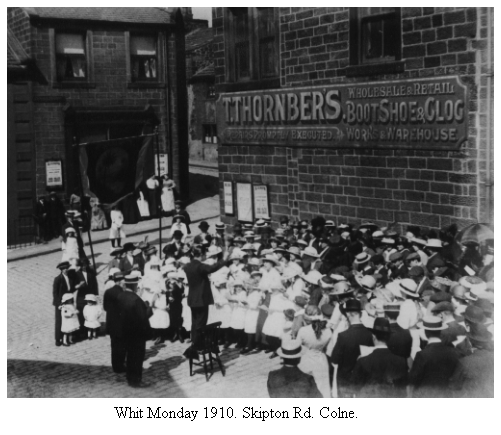
Those were the days of Whit Monday processions, stopping at the homes of sick or elderly people to sing well-rehearsed hymns en route, then returning to the Sunday Schoolroom to stuff ourselves with Johnny Spencer's sticky currant buns swilled down with tea. Chubby little Johnny Spencer was not only a baker, he was the Scoutmaster and the Sunday School Superintendent. After the bunfight we trudged a mile or so up Lidget to a field which was ours for the day, and the Scouts put up an ex-war khaki coloured bell tent and sold pop and sweets. We spoiled our best clothes, and everybody was hot and exhausted by teatime after playing improvised games of cricket and football and tig. On that field I tore a piece out of my left stocking and the calf underneath, leaving a triangular scar which is still there to remind me of the time I climbed up a fence to peep over at the lovely people all dressed in white, who were playing tennis. That was probably how my interest in tennis began, and years later I played with a team against the club where I lost a bit of the flesh from my left leg.
Yes - those were the days of hot summers, with tight shoes and prickly clothes; and of cold winters, with snow, and red knees, with goose grease to rub on your chest and into your leather boots to keep out the wet. Days of childhood.
We moved into a house with shop and office in town, and then the family increased in size. The shop was a new departure, and there was a display of mangles and other large household items, but it didn't work out - mother was too busy being a mother to bother being a shopkeeper. There was a younger sister, then a baby brother, whose death in 1923 at the age of nineteen days brought mother's sixteen years of childbearing to an end. The eldest, my brother Arnold, accompanied Dad on a tour of the Belgian battlefields, whence his emerging talents as a photographer became evident. Eldest sister Clara stayed home to help mother, my middle sister Gladys - who had me as a baby brother on her third birthday - became a tailoress, and kid sister Winifred mostly stayed at home. I suppose we were quite well off, with a telephone - number Colne 328 - on the office wall and an extension to the workshop, and a car in the days when cars were few. Bailey's houses were going up all over town and its environs.
Dad was a Baptist Deacon and lay preacher, and we seemed to feed a lot of ministers, especially at weekends. Chapel and Sunday School became part of our lives. We were a dull and contented family. There was a mysterious character who called on us from time to time, to be fed and sent on his way; he was known to us children as Uncle Arthur, and we understood him to be a tramp. We knew only a few of Dad's side of the family, but he was descended from the Scottish Douglas clan, a wild lot by all accounts. My mother, on the other hand, had Welsh connections, and Grandad Werrett, who was employed in his latter years by my father as a clerk, was a former coalminer from Blaenau in Monmouthshire. His was a fascinating personal history. He was a mining surveyor and overman, an amateur boxer, and the owner of a terrier which performed tricks for pints in his Blaenau pubs. Grandad used to box in Taylor's Boxing booth which toured Wales with the Fairs. After a wild youth, he was converted, became a tea taster and commercial traveller, a teetotaller and an evangelist. His Welsh fervour and talent for instant drama made him a great draw in the chapels. Young non-conformist Ministers called on him regularly in Dad's office, and the accounts were forgotten as Grandad held forth. He wrote the most beautiful copperplate. I loved him dearly.
Looking back now, I suppose the family atmosphere was stifling for a child in the middle of the age range; yet I can never recall any obvious sort of discipline. Friends were always welcome - mother was a wonderful cook - and there was no kind of curfew. Perhaps the very size of the family set a pattern of behaviour. There did not seem to be any great problems after the one tragedy of our baby brother's infant death. Dad became a Councillor in the local Liberal tradition, and that one factor probably influenced us more than anything else - except Chapel.
Oh yes - and Cricket. Colne Cricket Club was founded in 1830, and was in the Lancashire League. Lancashire League believed in each Club having a professional, and we children had some real live heroes to worship. My favourite was Learie Constantine, a West Indian with a large handsome wife and wonderful kids. He was a fine cricketer and a born entertainer, and he was Nelson's professional. When Colne played Nelson the whole town turned out. Colne in fact produced some professionals from its own team. All the North-East Lancashire Clubs had good professionals and played to filled grounds. From being a small boy I used to go with Dad on Saturday afternoons, and when I was old enough I went alone on Tuesday - early closing day - to watch Colne Firsts or Seconds.
The family building business obviously flourished, and as a small boy I revelled in the activity. A large area of Priestfield was developed with semis and short terraces - 'spec' houses - and almost all the men were directly employed. There were brickies and joiners, carpenters and cabinet makers, plumbers and plasterers. Two bricklayer brothers called Payne regularly laid 100 bricks an hour, and engaged in competitions with each other for the fun of it. One of them poured dark rum in his tea from a tiny bottle. Lime plaster was made from putty lime actually made on site, quicklime being slaked in barrels of water and then poured into onsite lagoons. Heaven help anybody falling into one of these limekilns, as my kid sister once did. The mortar for the bricklaying was brought from the town's refuse destructor, and it consisted of ground ash mixed with lime in a mortar mill. The common bricks were made locally too, and they frequently arrived still hot from the brick kilns. Local stone was used for the bottom part of the outside walls, and the firm's cabinet makers made real oak overmantels. If a young couple married into one of the new houses they were given a handmade oak hallstand. My brother decided he'd like to be a bricklayer, but that ambition faded when he chopped off the end of his thumb with the trowel as he was cutting a brick. He drove the firm's lorry for a while. But he was so talented that he finished up with a degree in handicrafts and became a teacher. His skill as a photographer led to his becoming an Associate of the Royal Photographic Society. Johnstons and other famous photographic suppliers used to send him new products - chemicals, plates and printing papers - to try out and report back to them. By that time we had moved into one of the new houses in Priestfield, and it soon became cluttered with photographic paraphernalia. Young brother became the photographer's labourer, crushing crystals in porcelain trays, rinsing the prints, standing by for interminable periods in a small darkroom lit by a single red lamp, and clearing up the bathroom. Photography as a hobby never appealed to me after that.
Dad's business was all-embracing. A.D.Bailey and Company were builders, joiners, cabinet makers and funeral directors. We did our own french polishing, made the coffins, doors, gates, mouldings - the lot. Coffins were made to measure in those days, and they were coated inside with hot pitch, then lined with padded fine material, and french polished. Milton Riley spent hours on the polishing, bringing up the gloss with loving care, his fingers stained with the 'button polish' as he stroked the pad of wadding and cloth soaked in raw linseed oil over the spirit varnish. All for a few hours of lying in state and then burial in the earth. But you could feel the reverence in the joiners' workshop when Milton Riley was at work on a coffin.
In those days there was an important difference between carpenters and joiners. A carpenter cut timber and fixed it with nails only; a joiner made joints in his timbers - 'joinery' meant doors and windows and other jointed work. The cabinet maker was of course the super craftsman. 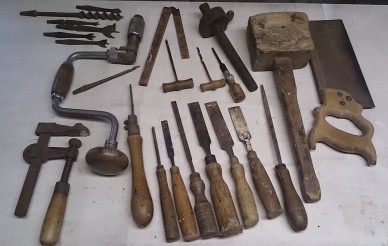
As I got a little older I learnt how to sharpen tools, to french polish, to plane and saw - and true craftsmen were my tutors. They also taught me that tidiness and cleanliness were a must, even in a joiner's workshop. Every day each man put away his tools and swept his bench. Nowadays when I look at my cluttered bench in the garage, I remember those men.
There are still some of my father's woodworking tools in my toolbox. They are used regularly, not as antiques, but as working tools. I am sure Dad would not have wanted them treated in any other way.
In those childhood days the firm's workshops were down Colne Lane, near the town centre, and opposite the Central Hall, a cinema which was purpose-built and the first of its kind. The joiners' shop and office were on the first floor, and the ground floor held all the machinery - a big circular saw, a planer, a morticer, a spindle moulder and a driller. They were all driven by leather belts which ran from a countershaft, just as in the weaving sheds. In our case, however, because overhead belts would interfere with the handling of lengths of timber, the countershaft was down in the cellar below the machines, and it was driven by a gas engine which stood on the ground floor, the drive belt passing through the floor into the cellar. The same cellar was also the receptacle for the sawdust and chippings from the machines above. Once only we had a small fire there, never an explosion. Starting the gas engine involved several men throwing all their weight into turning a big flywheel, so cranking the engine until the gas fired with a dull boom. Ignorance rather than courage attended those men as they unwittingly took their lives in their hands each morning to get the countershaft spinning. Modernisation of a sort came when the gas engine was replaced by an electric motor. All electricity was Direct Current in those days, and the starter was a big cast iron box on the wall, with a glass front showing copper or brass contacts arranged in an arc. There was a handle
on the front which had to be pushed over to make contact with those strips behind the window, then held there until the motor turned round. That handle had a kick like a mule. Right next to the electric motor was a three foot diameter sandstone grinding wheel standing in a bath of rusty water. When the big tools or cutters were being ground, water flew everywhere. Oh yes - exciting days for a small boy; and scrumptious feasts with Grandad Werrett, who used to take me across Colne Lane into Pickles's Bakery, to buy or beg burnt bun rejects. The cabinet makers used to dry their special timbers in the oven stoking room of the bakery, and next door were our main timber sheds. No fancy kiln drying in those days - the timber dried naturally.
Elder sister Gladys recorded her childhood memories of Colne Lane for my benefit.
"Dad's workshop in Colne Lane was a fascinating place. The sweet clean smell of fresh-cut timber greeted me as I entered - the smell of pine and oak and warm sawdust. Seasoned timber was brought through the town from Riddiough's yards and stacked until needed. Everywhere there was sawdust and the wooden curls of shavings as the planes smoothed out the bumps to finish the wood clean and true to line. Our two cabinet makers were Milton Riley and Jim Burt. Milton whistled all the time he made the coffins. Great pride was taken in choosing coffin handles, those made of silver being the most expensive.
Dad was a soft-hearted man, and made many a baby's box free of charge if the mother was poor; he was fond of children. Mother said she was sorry for any mother who had lost a child, as she had done - but making a box without charge would butter no parsnips!
Sometimes an adult's coffin had to be lead-lined because the deceased had suffered from dropsy. Once there was one made with a plain glass lid, showing the deceased man's face, so afraid was he of being buried alive. White shrouds were always made from flannelette with fancy stitching along the edges.
I once asked my mother why people needed white nighties when they were dead.
Glue was bought in blocks, light brown in colour and very shiny, and it was put in iron glue-pots with handles; the glue was melted on a stove fuelled with spare firewood. Staining and polishing were very skilled jobs.
All funerals were burials; in fact I don't think I heard the word cremation until I was about twelve years old.
There were some very interesting shops down Colne Lane. There was a herbalist called Shutt, where we bought Turkey Rhubarb, Mother Seigle's Syrup (for upset stomachs), root ginger, crystallised ginger, pudding spices, honey, flat locust pods, tiger nuts, licorice root, and all manner of kitchen herbs such as sage. Portly stoneware jars of nettle beer, ginger beer and dandelion and burdock stood in display on one side of the shop. Woe betide the customers in the shop if a cork blew out, to ruin clothes and spray the shop with foam.
There was a bakehouse called Pickles's, where we could buy large spoilt currant buns - delicious!
Mr. Thornber's shoe and clog shop was a favourite place to visit, lower down Colne Lane on the same side as Dad's workshop. I first remember visiting Thornber's with mother to buy some Sunday best shoes - or perhaps they were boots - I can't remember. They were to be worn for the first time on Whit Sunday. I do however remember crying out when the button-hook nipped me on the ankle. Mr. Thornber, a kindly round - faced man, patted my cheek and said "Sorry, lassie".
I still remember the old Central Cinema where we used to sit on benches for 1d or 2d a time. Favourite films were Charlie Chaplin and Buster Keaton. We devoured boiled sweets called Charlie Rock, which were wrapped in fawn coloured paper, flavoured with mint or pineapple.
The very last film I remember seeing there was about a cat which was going to have kittens. Before they were born the cat started playing with a large ball of wool. It chased the ball, caught it, chewed it, then when the kittens were born they each had a woollen knitted binder on. How we laughed and clapped! Sadly the old Central Cinema was burnt down.
Many years later there was a fire at our joiner's shop too, but not a serious one. I was about 11 years old then.
Grandfather Werrett travelled each day by train to be my father's book-keeper. As children we looked forward to seeing him, usually at 12 noon when he had a snack lunch at our house. His lunch consisted of cold bacon sandwiches and home-made biscuits. He always had stories to tell. One I remember was about the ghost of a dog which appeared down the mine in South Wales, saving the lives of Grandad and his companions just before an explosion. Creepy stuff. He amused us by doing tricks with coins and matches. His voice was soft and musical.
Mother encouraged Grandad's story-telling because it kept us quiet. All five of us."
By this time my formal education had begun at Lord Street School. In a family the older children play an important part in bringing up a younger child, helping to mould his personality. Not to put too fine a point on it, he gets knocked about a bit by the older ones. But in a school classroom each child shares experiences with other children of the same age. At Lord Street Primary and Infants School we were all children of the first World War when I was there. We were all therefore from homes which had felt the effects of War - many had lost their fathers, many had parents on the dole.
Some of the boys were called Verdun, in memory of the French battlefields where a million or so German and Allied troops perished between 1914 and 1918. Over 58,000 graves in 74 cemeteries testify to the folly and tragedy that was Verdun.
Coming from the comfort and security of my family and home, I began to identify with boys and girls from a wide spectrum of postwar working class society. During that period the teachers carried a huge responsibility. No doubt the way they discharged that responsibility gave me reason to remember them most vividly. First there was Miss Croasdale, Head of the Infants School. She was large and gentle, and always dressed in something like purple velvet. Those were the days of tadpoles and plasticine and little slates with scratchy chalks. In the Primary School across the big yard was Mr. Armistead, a roundfaced blond man, and his team of mainly spinsters - except for Mr. Capstick, a lovely terrifying man with a loud voice and a genius for discipline. There was Miss Sagar, a beautiful young woman, and at the other end of the age range was Miss Lomax, a scented and powdered blousy lady beside whose desk I stood in awe as I presented my work for inspection. There was one little lame teacher who suffered from excema, and she taught us about birds and small animals and had stuffed examples for teaching purposes. The art of taxidermy has always repelled me - how can they do it?
When I first went into the big school my sister Gladys was there too, but three years ahead of me. She and a beautiful blonde called Doris Whitehead were friends and were known as Buttercup and Daisy. Those were wonderful times, with teaching to heal the pains of the War - except for that dreaded 11 o'clock on the 11th of November.
* * * * * * * * * * * * * * *
Time came for the 11 plus examination. We sat for it on a Saturday morning, and we all knew who would be going to the Grammar School and who would be going to the Central School - there were no surprises. In August 1928 my year reported a mere 100 yards away at the co-educational Grammar School known colloquially as The Tech.
The Tech was, and still is, located in an impressive stone building which was part of a municipal complex comprising two Halls, a Technical College and the Grammar School. The Grammar School occupied all the upper floors plus ground floor domestic science and woodwork rooms and the gymnasium-cum-School Hall on the ground floor, whilst the Tech - mainly a textile training establishment and weaving shed - took the rest of the ground floor. The whole arrangement was utilitarian and compact.
The School playing fields were half a mile away, an absurd arrangement which involved trudging to and from cricket or football in all weathers, there being no such thing as a school bus in those days. But then there was no real physical education element in the curriculum in those days either. Swimming was under the supervision of the Senior French Master, a bald and bewigged lame man, a bachelor called Jimmy Tempest, who took us half a mile up the town to the Public Baths for our lessons. Other games were supervised by a maths master. We did cross-country running too, and I cannot remember who took that. In the co-ed Grammar School the girls enjoyed the services of a games mistress, and it showed. Highlights of the year for the boys were the annual girls' gymnastics display, when the girls removed their gymslips and bounced about in their blue knickers and blouses; and the girls' swimming competition at the public baths, when their proper instruction showed the boys up. I was never any good at swimming because I couldn't master the breathing.
The Grammar School might not have been much on physical education, but it was good on everything else. The first Headmaster I knew was an old soldier, Lieut.Colonel E. A. Howe, a disciplinarian and a great fellow. He had a good team of well-qualified staff too. I remember particularly Miss Mann, a tall angular History teacher; the myopic Miss Lucy Ward, a darling of an English teacher, who taught us the Greek alphabet as a special treat, and who gloried in the nickname of Tush: and Miss Grace James, a sallow-faced bowlegged junior French mistress, a vegetarian who seldom smiled, but when she did she showed beautiful even teeth and lovely dark eyes. The men included Mr. Pearce, science, Mr. Watts (Claude or Monty to us), the Art master, and Jack Beddoe, a young maths master who doubled at 'games'. Then there was a man called Mc Kerchar, who used to play Rugby, and he had a cauliflower ear.
Mr. Pearce failed to frighten us when, in a Science lesson one day, he told us about the unending chain reaction which would destroy the world if ever the researchers split the atom. Several years later, of course, they did - and we are still here. But he was a good teacher.
The Grammar School gave me a taste for drama. Col. Howe wrote and produced a lovely play 'The Courts of Abou ben Adam' - and the staff really went to town with it. The girls made a wonderful harem, the costumes and scenery were breathtaking to an impressionable boy, and I was hooked. Terry Land, the lanky insomniac English Master, gave me all the encouragement I needed, including an insight into Drama. He wrote a play 'Eldarc of Rockabye' and gave me the original script as a souvenir. The English Literature part of the curriculum allowed me to wallow in Shakespeare, Dickens, Galsworthy and Shaw. Wonderful days.
All too soon came Matriculation, when sadly rather a lot of my friends came a bit unstuck. Then came disaster. Col. Howe retired, and a very different Headmaster took over. He was a Men's Lacrosse player - who had ever heard of Men's Lacrosse? - he came from Manchester, and he was the first Master of Education I had ever seen. He was in other words a professional educationist, not an old soldier. His name was A. J. Phillips, and he came at the wrong time for me. I wanted to stay on to take Higher School Certificate, but as we all struggled to get somewhere, the new Head was reorganising the School. On some days we were without a teacher to take us for a period. The Head took us for Higher Maths., but it just didn't work. I left after a year. It was only after I left, and maintained contact with the school, that I found out what a nice chap A. J. Phillips was. Too late - I'd left, and went into the business with my father. That was in 1933.
In February 1933 the Oxford Union debated a resolution - " this House will in no circumstances fight for its King and Country. " The resolution was carried by 275 votes to 153. Winston Churchill attacked the Union for the resolution, thereby no doubt investing it with some importance; Churchill was an independent spirit himself. It is not too fanciful to suggest that the debate reflected the atmosphere in those days of postwar weariness and depression. Certainly as I left the cosy school environment to make my way in the world, I was to meet and mix with many who supported the Oxford Resolution in spirit, and the dread of War led to widespread pacifism and a mistrust of politicians.