| Contents | Foreword | 1 | 2 | 3 | 4 | 5 | 6 | 7 | 8 | 9 | 10 | 11 | 12 | To Australia on the former Kaiser's Yacht |
14 | 15 | 16 | 17 | 18 | 19 |
We went aboard SS Marella on Saturday 21 February 1942. The vessel was originally the private yacht of the German Kaiser Willhelm, and had been used as a luxury cruiser between Singapore and Australia. It was crowded to capacity with Malayans, wives and children of British and Dutch Colonials, and some service personnel. We were glad to meet once more the RNZAF construction unit, and they had had a bit of bad luck. After coming down the Malayan Peninsular, where I first met and made friends with them, and having crossed to Singapore, they finally succeeded in loading all their equipment on to a steamer in Singapore docks. They had salvaged every piece. As they were about to sail, the docks were raided, their vessel was sunk, and they lost the lot.
Before we sailed there was a scene on the wharf which indicated the attitude of the Asiatic crew. Some Chinese and Javanese refused to work, and they demonstrated their feelings by walking down the gangway with their wrists held out, demanding arrest. The efforts of a small Javanese Army guard failed. The RNZAF boys decided to use their own somewhat informal method, and their rough and rather physical intervention stopped the nonsense.
The Marella left Tanjong Priok in the early afternoon, sailing into the Sunda Strait between Sumatra and Java. A convoy was mustered in this narrow and dangerous neck of water by the cruiser Exeter, and what a strange assortment it was. The convoy speed was nine knots. After a few hours our escort comprising the Exeter and a destroyer left us, and the Marella left the convoy, as she could do twelve knots. As darkness fell we were alone, steaming south into the Indian Ocean before we could turn eastwards for Australia.
Victor Smith, a mechanical engineer called Watson and I shared a small cabin aft, over the propeller, on the lower deck. The cabin had no blowers, no fan, nor any ventilator. The port had to be closed at night for blackout. Our nights were sleepless in the stifling air. A form of dysentery put me in bed, and the Australian Doctor dosed me with Dr. Collis Brown's Chlorodyne, from a blue poison bottle. Apparently that physic was the medical mainstay in the tropics, especially with the Indian Army. My diet was a sort of custard pudding. When at last I was able to get about, the weather had cooled off and there was a refreshing breeze for our wellbeing.
The atmosphere aboard SS Marella was vastly different from that on the Narkunda, the ship which had brought me out to Malaya in 1940. The hardships suffered by the Marella's passengers broke down artificial barriers of reserve, constraint or snobbery which prevailed on the Narkunda. For one thing, we were all broke, and we all knew it. We had few personal possessions. All, that is, except a few Americans, who had left Java with all their baggage intact. These affluent passengers commanded the service of a high life, with lavish parties and smokeroom carousels which provoked bad feeling. Obviously jealousy and the depression of the situation were responsible, but one would have wished for more tact and sensitivity from the Americans. For my part, I was just glad to be alive and well. My new-found philosophy had begun to pay a dividend.
There were too many unaccompanied women on that trip. No doubt they were suffering from nervous reaction, some had perhaps given up to the situation, but the exhibition was amazing. My naivety probably coloured the scene a little strongly too. The blacked-out decks were littered at night as young girls and married women made an evening walk a hazardous experience. Rowdy parties went on into the early hours, and cabins became ports of call. This was no imagination on my part. The ship's master, for all that he was skipper of a former luxury cruiser where fun was the keynote, was obliged to make public his disapproval. He became most unpopular as a result. Generally speaking, the women had more ready money than the men, who, like myself, had escaped with just the clothes they wore and the cash in their pockets. So the women treated the men; and there were a lot of takers.
No attempt was made to keep the passengers entertained. Bridge became the main source of relaxation, and in the wet weather we played from ten o'clock in the morning until eleven at night, without stakes and with a skill acquired by sheer repetition. One evening a few soloists and a pianist provided a welcome relief; but the tedium was tangible. In an attempt to snap out of the depressing atmosphere, I started a letter home, ready for posting at our first port of call. Letters from Penang and Kuala Kangsar had flowed easily, with a vast store of experiences to relate. On the Marella my mind was a blank. We were the flotsam of war, drifting stragglers, washing over the Indian Ocean, useless and unwanted, not particularly caring which would be our next port of call. Escapees, tramps of the campaign.
At last the coast of Western Australia came into view to raise our spirits and provide a hope for more normal life.
The Marella tied up at Fremantle on a Friday, but we had to remain aboard until the Saturday morning. Victor Smith and I changed our Dutch currency for Australian pounds. My money came to ninety shillings - four pound ten. The Australian pound then was twenty five shillings to the English pound. We had to buy coat and trousers, shirt and socks, for the cooler weather. The thin, cheap clothing we bought was just about adequate so long as the weather remained warm until we could collect our salaries.
Vic and I were invited to a weekend party by a fellow passenger. We dressed in our new clothes and took the bus to town. The Saturday night bus was crowded with young soldiers, loaded with bottles of beer, out for a night on the town. Soon we had a community song session to get us in the mood for our night in Perth.
Every picture house was full, so we agreed to go to a dance hall. Our hostesses - one of the Marella passengers and her sister who lived in Perth - knew that we were broke, and they paid for everything without creating embarrassment. Once inside the dance hall we met some more young men, and for the first time for months we were able to shed our cares.
We missed the last bus to the docks at Fremantle, but nobody cared. Three boys from our new circle of friends put us up for the night in their flat near the Ocean Beach Hotel.
At 9.30 next morning we dressed quickly, and returned to the ship for a change of clothes and a shave. Back at the flat, we had a lunch of hot dogs, then we changed for swimming. The flat was virtually on the beach.
That Sunday bathing party was our first experience of Australian surf bathing. The breakers rolled in with a powerful deep roar, carrying with them hundreds of brown bodies as the bathers threw themselves forward in front of the waves and floated to dry land. We watched the experts, some with small wooden surf boards, and then tried it ourselves.
My first attempt left me breathless and surprised; the breaker rolled me over as I was turning for the first run in, and my head hit the sand. Soon however a sort of skill developed, and for an hour we soaked in the salt water and the sun on that lovely beach. I envied the young Australians who lived so freely by the Perth seaside. But above all, as we said goodbye to them and returned to our ship, Vic and I took away an indelible memory of our first introduction to Australian hospitality in their own country. In Malaya we were all strangers in a strange land, caught up in a war, all on a hiding to nothing.
The Marella was not able to sail until the Tuesday morning, and in the meantime some passengers had disembarked and the cabins had been rearranged for greater comfort.
The next stage of our voyage included crossing the Australian Bight, and the weather was rough, with huge waves breaking over the bows and flooding the crew's quarters. A heavy swell rolled the vessel from side to side, throwing chairs and carpets across the saloon and against the bulkheads. We were glad to steam into Melbourne on 10 March, where the ship was due to unload the frozen meat and tins of milk which had been loaded there in November 1941, intended for Singapore but never delivered.
Vic and I reported to the Malayan Agent in Melbourne, who had been posted there to deal with escapees. He was a Malayan Civil Servant, on leave when the War started, and he was a sympathetic listener. We each received five pounds, and we went into town to buy a few essentials.
Melbourne was a beautiful city, with wide smooth roads, good shops and a well-planned city centre. We spent days in the shopping malls and the wonderful parks. We sat beneath English Elms and willows, tropical palms and ferns, and Australian trees of many kinds.
The Americans had arrived, and they were made welcome with special shop displays and banners. American dollars were accepted in some stores - everything made easy for the Doughboys.
We saw the American soldiers, and we were impressed. They walked around in twos and threes, their pale khaki uniforms perfectly tailored, their shirts and trousers smooth, almost silky in comparison with British uniforms. There was a minimum of decoration, and their khaki or black ties - depending on whether they were Army or Air Corps - were simply tucked into their shirts. The piping on their forage caps was in varied patterns. The men were sober, smart and disciplined, a credit to their country.
The ship was going to be several days in dock, leaving us with time on our hands. We went to news theatres, but the only up-to-date film showed Gordon Bennett arriving in Australia from Singapore.
The attitude shown by the newspapers was decidedly anti-British. The public assumed that the AIF had borne the brunt of the action in the East, and that they had been let down. In fact, of course, the Australians did not go into action until the Japanese were sixty miles or so north of the Causeway.
A girl passenger took us one day to Sandringham to meet an Australian family. The mother was immensely proud of her two sons serving in the Australian Royal Navy, and clearly terrified by the Japanese. She intended to buy a revolver and to shoot her two lovely daughters if the Japs invaded the country. Her antagonism to us was palpable.
The general atmosphere in Melbourne was restless. News was sensationalised; the arrival of the Americans had stirred the public; there were troops, RAAF and Navy everywhere. The Japs had bombed Darwin, and huge posters showed a Japanese soldier clambering over the Globe from the Equator, a hand stretched out towards Australia. "He's coming South!" shouted the poster caption. Posters advertising one paper carried just two words - "Coming Nearer". Panic was in the air.
We were glad to leave jittery Melbourne on 18 March, and two days later we passed under Sydney Harbour Bridge and disembarked.
Rain was falling heavily. Coming from Malaya, where tropical storms had hampered defence works and caused disastrous floods, such an experience as rain was nothing to us. In Sydney it was a different matter. This was the first real shower in seven years, and the subject of most discussions. The drought in Sydney had become a serious problem; water was very scarce, hot baths were illegal, and only cold showers were permitted.
We reported to the Malayan Agency, but it was Saturday, almost midday, so we were told to find accommodation for the weekend and to report again on Monday. The Metropole Hotel was recommended as cheap and convenient. The room we were given had twin beds, cost fifteen shillings a night, and food was extra.
Vic and I pooled our financial resources. Our total funds were thirty three shillings. After paying for the hotel we would have three shillings for food for two days. You can't be much more broke than that.
Fortified with the knowledge that cash would become available on Monday, and because the hotel didn't ask for payment in advance, we decided to enjoy our weekend. We went to the cinema - '49th Parallel' - and we had a good feed after our monotonous ship's rations.
Sydney was asleep on Sunday. The rain had stopped, and we walked in Hyde Park, read a newspaper, walked again. We were probably not so much bored as restless, not knowing the future. The park sculptures were crude, mostly nudes, and that of Captain Cook was appalling. The towering figure had a huge hook nose, and the Captain stood looking over Botany Bay as no seaman ever would, with a telescope propped on his hip in such a way that in silhouette it looked like a giant erection.
Apart from the excitement of Hyde Park, where couples sat or lay on the grass, the occasional tramcar clanging and careering down the street, and a little bit of birdsong, the city was dead. Roll on Monday.
Monday was taken up with reporting, long tram rides, and walking. We also found new and more comfortable digs. Our new place was Macleay House, a small Guest House in Macleay Street, at Potts Point, near to Elizabeth Bay and a wonderful view of the harbour. We didn't know that it was also near to the Red Light area of Sydney, but one can't have everything.
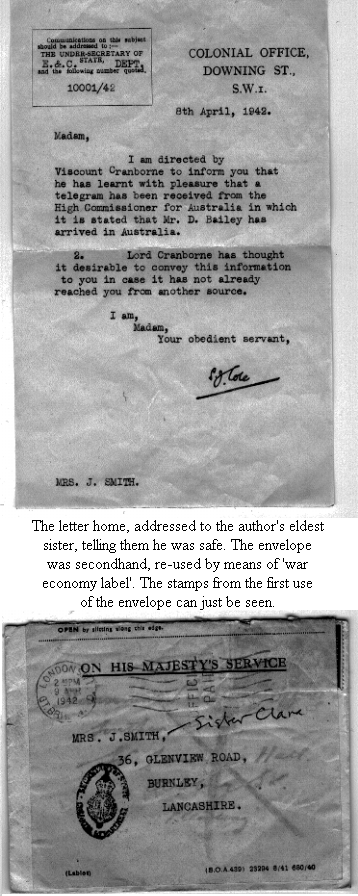
We considered our futures. The Malayan Agency had warned us that we might be given notice by the Government, but in the meantime we must not take up any paid employment. In effect, we just had to sit around and wait. All we wanted to do was to get home to England.
The rain started again. Four days of tropical, sheeting rain made news. The papers recorded the refilling of the watersheds, and at last the Paramatta River had begun to flow. Vic and I were drenched several times, and we had several drying-out sessions in our shared room. We had to go out, to rebuild our wardrobes and maintain our contacts, and we were glad when the rain stopped and the sun shone again.
Sydney was all bustle and noise, its main streets too narrow for the traffic, Martin Place partially taken up with a hut and platform for recruiting, and Pitt Street obstructed by a wall of wood and steel and sand in front of the Post Office. After a short time we stayed away from the centre, preferring Bondi Beach and the parks. Time lay heavy on our hands, and we decided we must do some work.
The Australian Institution of Civil Engineers couldn't help me, but Vic fared better at the Architects' Institution, who advised him to go to the Department of the Interior. We both decided to go along and offer our services.
Perhaps two young men seeking unpaid employment created suspicion, but we both experienced great difficulty in making a favourable impression at our interviews. We were told to apply in writing, listing our qualifications, and to obtain permission from the Malayan Agent. After several days we were accepted. Vic was to work on camouflage, I was in the Civil Engineering section. After a day looking at files, we were taken out to our working sites. My job was at the Kingsford Smith Civil Airport several miles out of Sydney, where I met the Resident Engineer. He had worked in Malaya for a time, so that we had something in common. He was leaving for another job in a few days, and the general idea was that I would take over from him. There was something wrong about the organisation there which made me uncomfortable - a lack of drive or sense of purpose.
When we got home, Vic and I compared notes, and he too was unhappy with the job he was supposed to do. We decided to return to the Head Office and make a few points, seeking more clear-cut authority. We must have been successful, because Vic was stationed at a distant aerodrome in charge of camouflage, and I was appointed Resident Engineer at Kingsford Smith. I was to extend the runways so that the airfield could take American Bombers.
The engineer in overall charge of the work turned out to be a 'pommie' - an Englishman, and he was a native of Salford. Seventeen years abroad had not erased his Lancashire accent. He had several other sites to look after, and the runway extension job had been allocated to me because of its size and the need for detailed and continuous attention. The runways had to be doubled in length, a great deal of drainage work was involved, and the field was rather flat, necessitating careful attention to levels - and work must not interrupt the day-to-day operation of the airfield. The American Army Air Corps had already taken over the aerodrome, and the job was urgent.
A new hut had been erected on the job for my use. At last there was worthwhile work for me to do. The travelling to and from Sydney - by tram past the Cricket Field at Mascot - would be expensive, and no expenses were payable because I was not on the Government payroll; but that didn't matter, so long as I could be doing a useful engineering job whilst waiting for orders from the Colonial Service. Standing by my new office, watching the scrawny rabbits darting about in the coarse grass and scrub, it seemed to me that here was a chance for me to build something, which would be a welcome change after weeks of destruction in the scorched earth policy of the Malayan retreat.
Two men were in charge of the work as supervisors under my control. One was introduced to me as Olly, the Maintenance Officer; the other was John Dooley, known amongst his friends as Honest John.
| Contents | Foreword | 1 | 2 | 3 | 4 | 5 | 6 | 7 | 8 | 9 | 10 | 11 | 12 | To Australia on the former Kaiser's Yacht | 14 | 15 | 16 | 17 | 18 | 19 |