| Contents | Foreword | 1 | 2 | 3 | 4 | 5 | 6 | 7 | 8 | 9 | 10 | The Battle of Singapore, and the Escape |
12 | 13 | 14 | 15 | 16 | 17 | 18 | 19 |
Singapore Island measures about 25 miles from west to east at its furthermost points, and perhaps 12 miles from north to south. The city is located on the south side of the island. The Causeway connects the island with the mainland, otherwise there is a narrow strip of water, the Strait of Johore, between Johore and Singapore. The final phase of the mini-war of Malaya was to be waged on an island of about the same size and shape as the Isle of Wight.
As we went along Bukit Timah road from the Causeway we saw the guns pointed towards the Causeway and the troops being mustered for the last stand. The roadside was packed with vehicles of all types, including steam rollers, tractors and army cars. My first destination was the Rural Board Depot, where I was to receive instructions.
The Depot was chock-a-block with lorries and tools and materials from all over Malaya, ready for issue to construction units of Australian Engineers and the Indian Royal Engineers, and we were to work with them.
Four of us were instructed to report to Major Bhagat of the Indian Royal Engineers, whose brother was the first Indian VC. His unit was at Jurong village, half way between the Bukit Timah Road and the west side of the island.
We received our orders. Three rough roads were needed between Jurong Road and Bukit Panjang Road, a road parallel to Jurong Road and to the north. Their purpose was to feed artillery units and to serve as detours in case of damage to the other roads. We had to get a lorry and find coolies, and other items would be supplied. Simple - no plans or estimates, no details; just get on with it.
We had to start on the roads next day, so I went to a billet which had been allocated to me in Ridley Park. There were five other men there, and it was agreed that I should share a room with an architect called Victor Smith, who had arrived in Singapore only the previous April.
Next morning, 31 January, we took three lorries to the Causeway and picked up seventy five Chinese coolies who had just finished demolition preparations there. Jo Cavallo stayed with me and drove a lorry. Another engineer and I drove one each. We carted broken stone, coolies riding behind and the three of us not only driving but supervising the job.
The sheer enjoyment of the rough and tumble job, riding over bumpy ground, and the company of the tough little Chinese, made it easy to forget the Japanese threat. Although I was in uniform, tin hat and all, there was no atmosphere of constraint between us, and we shared snacks in a nearby coffee house. Morale was high. Above all I felt that we were doing worthwhile work, humble though it was.
As night fell - suddenly, with almost no twilight - we went home. All was quiet. The Causeway was blown up at the Johore end overnight, the Argyll and Sutherland Highlanders formed the rearguard and piped their lads across to their last stronghold, and the Siege of Singapore began.
February 1, 1942, our first siege day, was calm. In the morning I went into Town to the Bank and the Office. Shops were operating as usual, Raffles Hotel was as busy as ever, and only the crowded streets and stores told of the tremendous number of people on the Island, troops and evacuees adding to the resident population and taking up all spare accommodation. The LDC, intended to operate as a Home Guard, had been disbanded, and the officers were wandering about aimlessly. Police Officers, without police or offices or duties, were passing time as best they could. The PWD office was filled with civil engineers from all over Malaya, superfluous. We younger ones were lucky - we were given the rough-and-tumble jobs with the field companies. Senior engineers were roof spotting. A brief chat with Horsley revealed that he was going to do a bit of bricklaying, building blast walls to convert a PWD garage into an air raid shelter.
I was glad to return to my road construction job, where several ditches had already been culverted, and that day I drove a temperamental Fordson tractor, its metal seat burning through my thin cotton shorts and a non-existent brake filling my job with exhilarating hazard. Soon we were laying laterite over the broken stone, and a passable road began to emerge.
On February 2 the gang was at work on the road when twenty seven Japanese bombers flew over on a raid, and the coolies scattered. After that initial fright however we were able to continue without interruption. Next day our gunners started shelling the Johore coastline, and work went on despite another visit by the bombers.
An Australian unit settled in the estate alongside one of our roads, and I enjoyed tea provided by their camp kitchens. An air of normality and order prevailed, with our artillery pounding the Johore coastline. Some of the gunners had a few unkind words to say about the Sultan of Johore, and there were suggestions that some were aiming at his Istana.
February 4 started as a normal day's roadmaking, with our guns at work also, and a large bomber force passed over to bomb somewhere in town. In the afternoon however, as we were finishing laying laterite near the Bukit Panjang road, we became involved in a bombing raid. Our Australian friends made us take cover just in time, and I joined my coolies in a roadside ditch. Thin metallic whistling sounds rent the air, to be followed by deafening crashes as the small bombs fell into the rubber, tearing at the trees and leaving them weeping white latex. The attack lasted about half an hour, and we were glad to clamber into the lorry and head south. The Aussie cookhouse had suffered, and the cooks came from their trenches cursing and muddy.
When I arrived home at Ridley Park that evening I found that the morning raiders had visited that area, but the small bombs had caused only minor damage.
February 5 was much the same, and a pattern had begun to emerge. It was possible to recognise when the bombs would drop, because the leader of the formation gave a short burst of machine-gun fire as a sort of signal. Theorists suggested that the Japs were short of bomb aiming equipment, and only the leader could take aim. Between 120 and 150 small bombs were released by the formation. We noticed also that bombing took place always before noon. One explanation advanced for this was the prevalence of electric storms, which made flying in the midday sun difficult; another was the shortage of aircraft or bombs, which meant that the Japs had to conserve their resources.
On February 5 a solitary British fighter aircraft circled over us as the bombers made off. The unfamiliar presence gave us a little comfort. The bombers met anti-aircraft fire as they flew over us, and we had to take cover from the shell splinters, which fell around us and brought down leaves and twigs from the rubber trees.
Shelling continued from the rubber plantation, but now it was directed to the west of our position. The shells made thin curved whisps of vapour in the humid air.
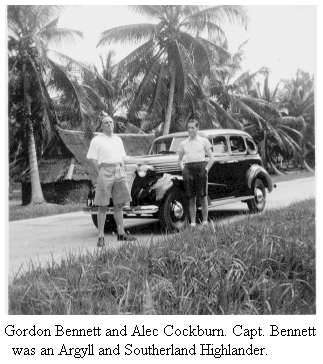
On February 6 I went into town to deal with my financial affairs and to collect mail from the PWD office. Whilst in town I checked up on my friend Alec Cockburn from Penang, and found that he had reached Singapore and was stationed on the east coast at Changi. That was the last I heard of Alec.
The Bank now housed all its branches from up country in the one building, each branch being established at a table in the overcrowded building. The place was packed with customers from all over Malaya. I was glad to see Harvey Ryves, my former next door neighbour in Kuala Kangsar. He was his usual cheerful self, in spite of having no job and no news of his young wife since she had been evacuated.
The sirens wailed their warning, and Malays, Chinese, Indians and Europeans were sent into the Bank cellars. The air was heavy with perfume, oil, perspiration, tobacco and garlic. After the raid I was glad to get out of town and head for the Rural Board Depot. There I collected cash to pay my coolies, and I headed for Jurong Road. Near the Ford works on Bukit Timah Road I was hailed by four soldiers. They were Australians, and they had just survived a bombing raid on their Bren gun repair workshop behind the Ford works. They were muddy, torn and breathless, looking for a lift to get back to base. I took them to the Jurong Road junction, where they could stop a vehicle heading for town.
The afternoon was quiet, our work almost finished. Guns and vehicles were using our new roads, and we finished the day repairing potholes and soft ruts formed by the heavy wheels.
Next day, the 7th, there was evidence of increased activity, with lorries parked in the shelter of the rubber. Another unit had arrived, and their job was to shell the Jap gun positions on the coast. We were asked to dig trenches in case the fire was returned, and we dug these about fifty yards forward of the gun positions. On the word, we took cover, and the guns opened up. Now the experience of field gunfire when one is fifty yards in front is startling, the noise ear - shattering. The guns fired again and again, brilliant red-orange flashes blinding us and the roar lifting us out of our skins. After the barrage the soldiers ran forward to join us in the trenches. There they waited for the Japs to reply. There was no reply. The NCO noted this with satisfaction, and the gunners dismantled their guns and moved on. The guns they had put out of action were apparently those which had harrassed us on the 4th. No shells fell in our area thereafter. I was impressed with the cool efficiency of the operation.
On the 8th I had to go into the southwest quarter of the town, and I ran into an air raid. Ack-ack started as the syren wailed - the Japs had only a short flight to get to us - and puffs of white smoke appeared overhead. I dived into the roadside drain to escape the shrapnel as it fell around me. Splinters whistled down and buried themselves in the road asphalt with the sound of a pebble hitting mud, or bounced off the stonework with a 'peng' of ricochet. Of course the ditch was no protection, and I abandoned it as the ack-ack moved in the direction of Fort Canning about half a mile away. The raid lasted half an hour. My car was undamaged, and I made for the PWD Office, now at Mount Pleasant.
After turning into Stevens Road, I was opposite the Tanglin Club when a loud screaming whistle rent the air and ended in a loud crash which shook the ground and made me jump in my seat. I pulled up sharply and was opening the car door when a second ear-shattering scream hit me. The explosion that followed caught me as I left the car, and I fell flat on the road. The deep roadside ditch offered me cover, just in time for the next shell. The screaming whistle was worse than the bang, as it always seemed to be coming for you.
The raid died away after ten minutes, and I emerged to finish my call at the office and to get back to Jurong Road. Looking back, I realise that we were beginning to accept daily air raids and shelling as part of the routine. After all, the siege had been going on for eight days, and we were still working with coolies, repairing roads and calling into town.
Then came February 9.
I was up and about early that morning, and the rumble of artillery was louder and heavier than previously. I set off for Jurong Road at about 6.30 in the cool fresh morning air which had followed the light rain of the night. I had gone only a mile up the road when I saw a file of men walking, stumbling, dragging themselves along the grass verge towards Bukit Timah Road. Some were barefoot, some shirtless, a few without trousers. One had a tommy-gun, few had weapons, none carried any kit. They were covered in mud, scratched and bleeding, exhausted, beaten.
When I arrived at the Field Company Depot at Jurong Village there were no outward signs of disturbance. Indian Sappers were preparing land mines under the watchful eye of a sergeant, our coolies were ready for work, all was orderly and efficient.
Then, as we were sending the lorries out with the coolies aboard, three Jap aircraft flew low overhead from the west. Seconds later we heard the bombs behind us. They were bombing the road.
Anti-aircraft shells exploded above us, and a British fighter engaged the bombers. We sought shelter under the trees. Jo Cavallo was near me, and we took cover together, wondering what had happened to our coolies in the lorries.
The Japs seemed to go mad that morning. Braving ack-ack and fighters, they dived from all directions, weaving madly in steep dives over the road and our hiding place. They circled and swooped, roared down at us with deadly bursts of machine guns, dropping their small bombs in the rubber, then climbing steeply in a show of aerobatics such as we had never seen before. There must have been fifty aircraft in action, and the raid lasted probably an hour.
The raid finished, and we took stock of our position. We had been standing amongst stacks of gelignite, guncotton, fuse, detonators, drums of oil and petrol, and all the paraphernalia of a Royal Engineers unit. Dispersed though it was, the most distant stack of explosive was only fifty or sixty yards away from us. One small bomb on one of the stacks would have laid every tree flat and scorched the earth. The Jap bombers had missed the lot.
Our coolies came back into the depot. They were frightened but unhurt, having taken cover only a short distance up the road. A lorry came in with wounded men, and two inert figures laid on boxes between them.
Then we were told what had happened. The Japanese had made a night landing in force at a point on the west coast. They lost men heavily at first, but kept piling in and gaining ground. The Australians had been pushed back to the edge of the rubber, and then the sniping began. The Japanese were masters of the art of jungle warfare, and the skills they had employed all down the peninsular were brought into play once more in the rubber. A rifle was useless against the light tommy-gun, and the additional hazard of snipers was the last straw.
That landing, overnight on 8 - 9 February 1942, spelled doom for Singapore. It was the beginning of the end.
Work was abandoned for the day; the Chinese coolies realised that they were living and working in the most dangerous part of the Island, and they were frightened. It seemed unlikely that we would have a labour force on the morrow.
Driving homewards towards Bukit Timah Road, I saw what the Japs had tried to do. The AIF Headquarters was half a mile short of Bukit Timah Road, and that had been the target. Craters lined the road, mostly missing the carriageway, which was littered with earth and trees, wires and poles, stones and debris. Troops were busy clearing the road and restoring communications. Here again the bombers had missed their target, in spite of their numbers, and there was little doubt that the bombing had been more exuberant than accurate.
At the junction I picked up four Australians, all hatless, one bootless, two with rifles, two with grenades in their belts. They wanted to pick up a vehicle going to Base Depot, so I took them into town.
A telephone call from the engineer in charge of our quartet at the IRE Depot had me back in action. I was to get back to the Chinese coolies and bring them out of danger. The four of us met at the PWD Depot and took a lorry; I sat beside one of them with my revolver cocked in my hand, not sure what we would meet as we headed west.
A military policeman stopped us at the Jurong Road junction and warned us not to go up the road. When we told him our orders he let us go, but expressed doubts about getting to Jurong village.
Troops were still streaming down the road. Roadside camps were evacuating, Indian soldiers carrying blankets and packs on their heads, lorries loading up with fuel, stores, explosives and men. Groups of dirty, wet, ragged Australians were gathered round lorries to get their issue of bread and butter.
We reached the depot and gave the Chinese two minutes to collect their barang and families out of their lines and on to the lorry.
We took the precious cargo of faithful Chinese to the PWD Depot in town, put them in an empty storeroom, and went home as darkness was falling.
All the men at the Mess in Ridley Park were roused to action by a telephone call soon after I arrived home. We were told to report urgently to a Government Officer's quarters. There we were given one of the strangest jobs imaginable. There was in town a Corbeck McGregor's liquor store. We were to deny the liquor to the Japanese by smashing all the bottles and pouring their contents down the drain.
The night was pitch dark; we had to act quickly so that the local Asiatics would not rush the place. We worked by the light of candles and hurricane lamps.
Each case had to be carried down a winding flight of stairs to street level, opened, then the bottles smashed over a drain sump; all thirty seven thousand dozen bottles.
About seventy men had been mobilised for the task - ex rubber planters and Government Officers, some in Volunteer uniforms, some in LDC uniforms. We formed a chain along the upper floor and made a chute of planks, sliding the cases to the smashing gang on the street.
My first job was smashing. Two of us bent over the sump with hammers. and by the light of a hurricane lamp we broke the bottles at the neck and poured the liquor down the drain. The empty bottles then had to be repacked in their boxes and stacked across the road. It was a back-aching job. Gin, whisky, sherry, all the best British and the worst Australian, filled the air with alcohol until we were intoxicated by the fumes and had to be moved to a job where the air was clearer. I stood at the entrance with a crowbar, and when a case arrived at my feet I had to burst the wire binding and prise open the lid before passing it on to the smashers.
Half an hour or so later I was sent upstairs to join the chain of men passing the cases wearily along to the top of the stairs. Light relief came when somebody opened a case of beer, and the sweating workers were given a short break. I remembered that a sa-tengah - Scotch with soda - had cost less than a beer at the Kuala Kangsar Club.
Dawn was about to break when we left the liquor store. A small group had improved on the slow progress by rigging up a tank out of tarpaulin on the first floor, with a fire hose down to the drain. Our combined efforts had made little impression on the thirty seven thousand dozen bottles, but at least we had tried.
Next morning, February 10, an early telephone instruction called me to Head Office. I had to take food and be prepared to stay away from home indefinitely. The job was demolitions.
As I drove to the office my mind went over the work I had been doing over the last two months. Apart from building a temporary makeshift bridge and laying down rough roads, my work had been destructive. This was not the work of a budding engineer, which is that of harnessing the forces of Nature for the use and convenience of Man - not my words; not the work which makes the profession adventurous and full of achievement, the work of building, creating useful things out of bricks and stone, wood, steel, man-made materials, monuments to the skill of the craftsman, the brains of the designer, the inspiration of the pioneer. For weeks I had been destroying, or helping to destroy. All my starry-eyed ambitions were taking a bit of a knock in Singapore, and last night had been a comedown to rock bottom.
On arrival at Mount Pleasant HQ I was glad to exchange a few words with Jo Cavallo. As he came from Malacca, I asked him if he knew Robert Partridge. It transpired that they had been at Kuala Lumpur Technical College, though in different years. Partridge had reported to PWD at Malacca as promised, and was working on Civil Defence works until the Japanese came. He had stayed there to be with his girl.
Then I thought of Brawn, the workshop foreman. Apparently he had gone from Kuala Kangsar to Kuala Lumpur, then on to Singapore.
My orders were set out. I was to go to the workshops of United Engineers, where coolies with sledge hammers would smash up the plant and machinery; then I was to go to the slipways and boatyards of Thorneycroft's and United Engineers and burn the boats. An engineer named Laffan was to work with me on this scorched earth exercise.
We had to wait until the mechanics and fitters were paid off, and we made such plans as we could as we waited.
"Well, old man, it's Formosa for us", said Laffan. I looked at him sharply. Laffan was an odd bloke; he had an irritating loud laugh, a nervous laugh which erupted at the least chance, and his remark was the sort of thing he could be expected to say. But he was dead serious this time.
"What's the position?" I asked. "Does this mean we're packing in?"
"Just as soon as we can finish smashing the place up" he replied. "We've been told to smash all we can, and they'll probably surrender on Thursday."
Laffan told me that his wife and children were safely away; then he raised his sights to make a remarkable statement. "It's not so bad for such as myself", he said. "I'm not so young as I was, and I've been in the country long enough to get a decent balance in the Bank at home. But it's worse for you boys, who've only been out a year or so. You've spent all your cash, probably, to get out here; and you've started with high ideas and lots of enthusiasm. Now it's gone, and you probably haven't even a wife to look after things for you whilst you're a prisoner of war. I've got my service in for a pension, and you've not even been put on the permanent establishment."
I remembered that Laffan, on the occasion of our first meeting, somewhere up-country during the retreat from the north, had said that the Italians could never be our enemies - they were too nice for that. Laffan was a most unusual man.
The last of United Engineers' employees left the buildings, and our Chinese wrecking gang arrived. We entered the workshop.
Everything was neatly in place as if the works had closed down for the weekend. Huge lathes and other machine tools stood idle, oilcans and rags laid aside, and shiny swarf lying on the ledges and round the machines. Hand tools were on the benches. We knew that Australia was crying out for machine tools.
Laffan exchanged a glance with me, then walked to a lathe and pointed out the gears and other vulnerable points to the coolies. I did the same, and the smashing began, the air ringing with the crash of sledgehammers on the fine machinery.
Whilst we were engaged on this shameful destruction a British member of the staff stormed in and asked me why I was committing the crime. He was overwrought, and as an engineer I felt deeply for him, but I pointed out that we were only doing our duty, and he went away, saying that he preferred to leave the machines to the Japanese rather than witness their destruction.
We did as much damage as we could to the machinery, and I took some coolies in a lorry to the slipways. We had petrol and oil to start the fires. A senior member of the department pointed out the things to do, and then left me to it.
First we started again with the sledgehammers, whilst doing a reconnaissance around the yards. We discovered that people were still living close to the slipways, and would have to be moved to safety before we could start the fires.
There was some activity at the Thorneycroft slipway. A few ratings who had survived the sinking of the Prince of Wales and the Repulse were hanging around, waiting for the departure of a minesweeper. Three or four gunners from an anti-aircraft unit which was defending the nearby civil airfield were loafing about disconsolately; they had had a few beers, they were dirty, and they were dog tired. I gave them a sledge hammer so that they could vent their feelings, and they smashed somewhat unsteadily at the machinery. One of them offered to put a shell through the workshop roof, but I demurred for safety's sake.
A beautiful white Napier engine lay on the side of the slipway, together with several new Thorneycroft engines. One was still in its crate. They were to have been installed in some new 75 ft Naval Patrol launches which were almost completed in the sheds. One by one we wrecked them all.
The job was done except for the burning of the boats, and the coolies got on the lorry. As we headed homewards my mind was in turmoil. Things were bad if we had to resort to the sort of destruction we had been ordered to carry out that day. Desperation seemed to be the main force, and we had no idea from one day to the next what would be required of us.
Back at the Mess the atmosphere was tense; there was little conversation, but we were all thinking the same thing. Were we supposed to stay put, or had we to get out? I was about the only man with work to do; the others were at a loose end, their jobs having disappeared in the chaos. Nobody had received any instructions.
After our meal, as we sat around trying to assess our situation, I suggested that, as I was returning to the Slipways in the morning, they could go with me to see what could be arranged for our escape. For instance, there was a small boat, about 14 feet, almost completed, with a petrol engine partly fitted, and perhaps some of us could get it finished and running. We estimated that we could reach Sumatra in about six days, and somebody worked out a list of minimum rations of food and drink. We agreed that with six men aboard there would be room for only the barest essentials of clothing. As we worked out the details, at least we felt that we were doing something positive. The atmosphere brightened perceptively. We would make things happen and not just wait for things to happen to us.
That night the Japs were shelling us and guns placed near our Mess were replying. We were all awake at 4 am to the sound of machine gun and rifle fire, and from the noise of the field guns I could tell that they were firing over the house.
I packed a few things into my black kitbag, including a magnetic surveying dial and a ruler, for navigation. One of the architects tore the bottom off a map of Singapore which showed the islands to the south and some of the sea between us and Sumatra. Of course we had no idea where any mines were.
We went to the Slipway in two cars at 5 am. Tractors were trying to patch up the airfield, and netted temporary hangars were erected on the roadside. A few fighter aircraft were parked along the edge of the carriageway. The flying ground was littered with plane wrecks, and the buildings were torn by explosions. The RAF were using the road as a runway.
As soon as I thought somebody might be at the end of the telephone I rang HQ for instructions about burning the boats. A senior engineer answered. "I'm at the Slipway. Have I to carry on?" "No, do nothing yet. Stay there and wait".
I waited an hour. Still no orders. In the meantime one of our party had been speaking to a Naval Reserve officer who was loading a small river launch at the jetty. They were leaving that afternoon, and they needed a crew. Their destination was Batavia.
The senior engineer in our party decided to go to HQ to clarify the position. I rang HQ again. "Any orders about the firing?" "Not yet. The Navy wants us to wait." "What is the position? Is it a case of every man for himself, or have we to wait for instructions?" "I think it's every man for himself, but things are chaotic here. Make your own arrangements if you can, but keep in touch with me as long as you can."
Once more I waited, until the senior engineer returned with his news. The Director of Public Works had received permission from the Governor for the Department to evacuate. We had to find our own way out. I had to deny a tank containing thirty thousand gallons of petrol, and to wait then for word about burning the boats.
We were told that Ridley Park was now cut off, so there was no going back.
The other engineer and I found the petrol storage tank near the jetty, and we opened the cocks so that the petrol ran out into the bund around its base. Then we sat waiting.
The syren wailed an alert, and we took cover in a building. Otherwise all was very still, the street deserted. Tanjong Rhu was empty.
Somebody came to tell us that we must not touch the boat yards.
So that was that. We boarded the Panglima, the 75 ft launch, and were given our crewing orders. My job was cook for sixteen. We were all to take watches for aircraft and submarines.
The launch was one of three which had been in Thorneycroft's, and her engines were dismantled. The mechanics had left before the vessel could be powered. The other two launches were brand new, in fact not finished, and only one could run its engines. The minesweeper had no engines. The four craft were to be towed to Batavia by a harbour tug.
The tug took us out into the harbour, where we hove to and made fast the towlines, checking up and getting into line. The minesweeper was the first in tow, and the three launches followed. Our launch, the Panglima, was the last in the tow. We started our voyage at 3.30.
We were barely on our way when Japanese aircraft came over. We were taken completely unawares. The sea shuddered, and a series of explosions resounded across the harbour. I was making coffee in the tiny galley at the time, and I crashed against the bulkhead.
The raid ended quickly, leaving a few vessels foundering, but our convoy in tow was undamaged. We were potential sitting ducks, and one of the ratings on the minesweeper shouted "Get a bloody move on !" We left the harbour and headed south.
| Contents | Foreword | 1 | 2 | 3 | 4 | 5 | 6 | 7 | 8 | 9 | 10 | The Battle of Singapore, and the Escape | 12 | 13 | 14 | 15 | 16 | 17 | 18 | 19 |