In 1948 the family moved to South Wales, as a chance came for another small step up my personal career ladder. Though the move might not have appeared particularly significant to us at the time - it was just another job - that step led to the opportunity of a lifetime; the privilege of participation in a unique exercise resulting in the development of a grass-roots understanding of Europe, and of Germany in particular.
My first visit to South Wales had been in July 1948, when the overnight train from the north of England took me to Cardiff, and a connection from London took me to Neath.
A steady drizzle greeted me at the station. So did the musical sounds of Welsh voices. This is no imagined or contrived impression designed to elaborate on the Welshness of my first experience. The lilt and cadences were there, to be impressed on my memory for ever. No matter that they arose merely from the activity of the porters and ticket collectors on the station, together with the voices of passengers catching the morning train. On my first call at Neath there was a musical greeting which will never be forgotten.
That was the day of the job interview, and I returned to Buxton to give in my notice.
At the end of September we travelled to Neath and entered our new home. The day was Saturday, and the news came through that Glamorgan had won the County Cricket Championship under the captaincy of Wilf Wooller. Wilf Wooller had been a prisoner of war under the Japanese, and that to me made the achievement all the greater. We were soon to learn that Neath had produced some top class cricketers, and it does so still.
Before very long we were to discover that Neath was the birthplace of the Welsh Rugby Union; the Union was founded at the Castle Hotel. More importantly, Neath RFC was - and still is - a premier club in the Welsh Union, producing players of top international class.
Very soon also we found that the Vale of the River Neath, which gave the town its name, was once a mecca for landscape artists; that the town was of Roman origin, with a Cistercian Abbey and a Norman Castle; and that it was once the centre of a thriving coal, iron, steel and tinplate industry. Modern industries such as oil and plastics, packaging and new technologies have taken the place of heavy industries, and today the town centre reflects the march of progress at the expense of narrow old lanes which once boasted inns every few yards.
The river Neath meanders in a broad valley, and it is tidal from Swansea Bay to a point well upstream of the town. There used to be a wharf close to the town centre, and there are still working wharves downstream. As for Swansea Bay, the sweep of the coastline from the River Neath to the west is impressive, and once the eye has passed the Docks and the new Marina it is beautiful, with Mumbles alive with people messing about with small boats. Once past Mumbles Head there is the Gower Coast, the first bit of Britain to be officially designated an area of outstanding natural beauty.
So this was the setting we found for our home, and soon it was to be the birthplace of our second child. The Gower beaches became our family playground, Welsh people were godparents, and very soon we were accepted in the community.
In fact Neath is not intensely Welsh. There are a great many residents of Italian origin, arising from the migration of Italian steelworkers, and with them came restaurateurs and fringe businessmen. The advent of the Great Western Railway brought many families from the West country.
The people of Neath we found to be artistic, musical, tough sportsmen, blessed with tremendous good humour, and tolerant of foreigners. In this largely industrial town the Welsh inhabitants murdered the Welsh language, and few spoke Welsh at home. The local English is spoken with a variety of Welsh accents, some attractive and some horrible. The idiom can be hilarious. Soon our north-country accents and idiom were good for a laugh also, and into the rich soil of good humour and tolerance and real friendship our roots went down, and spread, and there is now no other place we wish to live.
There was a massive backlog of work to do. I was now a Chief Officer, and first there was a Department to rebuild, as the old men retired and the young ones came back from War service. Not only were houses needed, but the town's water supply was a joke, with curtailments after only a few days' dry weather. The roads were neglected, and choked with traffic. There were no playing fields, no public baths. Slowly but surely we extricated ourselves out of the mess, making mistakes but making progress as well. Thankfully we were able to hand over our small water undertaking to a bigger authority eventually.
In the middle of this exhausting but challenging task of post-war reconstruction there came an entirely novel and exciting experience which was to establish a third dimension to our lives and to educate us in matters far beyond the anticipated scope of a Welsh provincial town.
Britain and her Allies had to endure an uneasy peace in the postwar years. So tense was the situation that in spite of the need for reconstruction at home, the Government introduced National Service - conscription - to provide for problems in Malaya, in Cyprus and elsewhere, and to supply the British Army of the Rhine. Young men were sent for military training as soon as they had finished at college, or at the end of their training. The usual stint was two years, a disturbing interruption for youngsters at the start of their careers.
In the troubled years following the end of the war, one particularly unhappy incident was graphically recorded by John Reading, our friend who had come to Britain with me in 1942. As correspondent for the Sydney Morning Herald, John covered the invasion of Suez when Colonel Nasser decided to nationalise the Canal, following the decision of Britain and America not to give financial support to the Aswan Dam project. The Canal was British and French owned and financed, and the two Governments decided in 1956 to use force to protect their interests. Shades of Empire. They invaded Port Said.
In November 1956 John sent us his personal account of the adventure :-
"As you know, I went off in a deuce of a hurry with a crowd of other accredited correspondents, flew via Nice, overnight at Naples, then Athens and so to Nicosia, was clapped into uniform, swore fealty to the Queen, and was 'alerted' to take off for Port Said at a moment's notice. As things turned out, with all the diplomatic and military messing about I didn't get to Port Said until the Wednesday night, so we poodle-faked at the Ledra Palace Hotel in Nicosia, making odd excursions to airfields and camps in various parts of Cyprus and attending headquarters conferences at which nothing was said because nobody knew anything. Cable delays were up to 18 hours, there were senseless censorship stops, and the public relations set up was on the level of the first week of 1939. Nicosia was an armed town, and with military preoccupation with Suez, the terrorists were making hay. We couldn't go out at night, there was a curfew, anyone in uniform was fair game. You travelled with an armed escort in any vehicle, there were road blocks and searches for hidden arms at frequent intervals, even the children going to school had tommy-gun escorts who watched over them while they played in the school grounds. Half a dozen people were shot while we were there; and only on Friday a journalist whom I knew well, Angus MacDonald, was killed in the 'murder mile' over which we several times passed.
"I wangled a trip to Port Said on the Wednesday night in an ancient Valetta taking in water and medical supplies, had to spend the night at the airport as the road in was mined and dangerous at night. Got into Port Said early next morning, bit of a shambles, still disorganised, sporadic sniping in the Arab quarter. Had to pass the cemetery which was fought over so stubbornly, there were scores of bodies heaped up like sacks of wheat on a truck, stinking to high heaven. Wonderful propaganda for Nasser if anyone had taken a photo. They remained there for another two days. Damage to Port Said compared to wartime bombing was, I suppose, relatively small, but in a place which normally looks so scruffy what damage there was seemed accentuated. There were grim gaps in the European area, and in the Arab quarter house after house had fallen on top of one another like collapsed cards. Several warehouses and public buildings were still blazing, and British patrols were busy winkling out snipers. Severest damage was along the sea front where the invasion took place. It extends for a distance of about 700 yards to a depth of about 300 yards. There was a certain amount of wreckage deeper but most of this was caused by cannon and rockets from naval aircraft which had to be used against isolated points of resistance. Strangely enough the Egyptian Tourist Board was functioning, the manager had fled but his assistant offered to send me anywhere I wanted to go 'as soon as things have quietened down a bit.' I drove along the desert road in the direction of Suez and over the canal bridge captured by the French in the first landing, a dry forbidding landscape dotted with tanks and here and there a camouflaged gun emplacement. Not a pleasant road, the sweet smell of high explosive and death hung over it. The British troops were making a house to house search for arms, there were truckloads of guns, several hundred of them Russian in mint condition, something smaller than a .303. They had been issued to the civilian population. A score or so of children aged between 11 and 14 had been caught using them.
"The Gyppos were afraid they would go short of food and had started looting. I got caught up in a minor food riot in a square in one of the most densely populated parts of the town, hundreds of Egyptians were wandering aimlessly about haranguing anyone in sight when suddenly there appeared a dozen or so Egyptians laden with sacks of flour and boxes containing biscuits and tinned meat and jam. They had been looting the Egyptian barracks nearby. No sooner had they reached the corner of the square than they were attacked by their nearest neighbours, fighting, snatching, clamouring for a share. Flour strewed the streets as the sacks were ripped open and wrested from one to the other, and tinned goods spilled from the open boxes. There was yelling, screaming, kicking and fighting. It would have been amusing if it hadn't been pathetic. The crowd by now numbered about a thousand. Word was sent to the patrolling Marine Commandos and they came up smartly with a tank and a Vickers gun, and formed up a line with bayonets fixed, and within five minutes had dispersed the rioters and sent them about their business without laying a hand on them, leaving the street corner inches deep in flour and with tins rolling in all directions. A number of Gyppos got away with some of the stuff but judging by the temper of the people who had none they wouldn't have progressed very far without a fight. One Egyptian threw a cosh, it hit a Marine on the head and he collapsed on to the footpath. He was not seriously hurt. Just as things appeared normal I'm dashed if half a dozen more Gyppos, laden with looted goods, came round the corner. Soon all was bedlam again and like magic hundreds of people once more milled into the streets and wrangling and fisticuffs broke out afresh. I left it to the Marines. There was plenty of food in Port Said and food ships were already discharging. There was very little, however, in people's homes, they'd been without shops or deliveries for a week. And anyway, looting and rioting comes naturally to the Egyptians.
"The Casino Palace Hotel had taken a beating. Behind in the garden there were temporary mass graves of Egyptian soldiers. The British troops were digging more. They were just slight mounds of earth each with a steel helmet marking the spot. Inside the hotel there was a casualty clearing station, medical equipment was spread out on the billiard table and orderlies were dispensing prescriptions from the bar. Egyptian military prisoners with blank disinterested faces were awaiting treatment.
"I stayed in Port Said off and on, getting a lift back at night sometimes to Nicosia where communications were much better. As soon as the business started to collapse I got organised and managed to get a seat in a plane bringing some Royal Norfolks for demobbing. We had a couple of hours at Malta to refuel, then flew on and landed, of all places, at Southend on Sea.
"I found the 'officer class' completely indoctrinated and propagandised and thoroughly Eden men. The rankers were a bit fed up and adopted the attitude that they had a job to do and the sooner they got on and did it the sooner they'd be out. What the outcome of the whole business will be is anyone's guess. Frankly, I thought the bombing of Egypt completely indefensible ... but I know the pros and cons of the whole affair can and will be argued until the cows come home. It is to be hoped that the end will have justified the means ..."
We were soon to know that the end did not justify the means, that the Egyptians blocked the Suez Canal with sunken ships, that world opinion was against France and Britain over the affair, and that Anthony Eden suffered a political defeat. Subsequent events indicated that in any case the Canal was of no great strategic or commercial importance because super-tankers had to go the long way round the Horn anyway, and air freight was quicker and more efficient than slow Canal shipping.
The Aswan Dam scheme went ahead with Russian help, enabling the Soviets to extend their sphere of influence in the Middle East.
John's letter highlighted the stresses for postwar Britain, with young men still having to be conscripted eleven or twelve years after their elders had been demobbed into civilian life, whilst the super-powers engaged in power politics across the World.
That was the situation in 1956 when the Foreign Office embarked on a programme of goodwill visits to Britain of West German heads of local government. In order to understand the background to the programme it is useful to look back at events in Germany about that time. The country was split by the Russians and the Western Allies. After the defeat of the Soviet blockade of Berlin by the Allied airlift, the East German Republic was founded in 1949. Russia proposed the reunification of Germany in 1952. In 1953 the Bundestag approved the European Defence Community. In March 1954 came the Soviet declaration on East German sovereignty, in October the Western Allies' invitation to West Germany to join NATO, then the end of the occupation of West Germany by the Allies. In 1955 the Warsaw Pact was concluded, with East Germany as a member. West Germany outlawed the Communist Party in 1956. Those were dangerous days, the days of the Cold War.
The goodwill visits were arranged in order that the new leaders of towns and cities in West Germany could see how local government worked in Britain. In the case of South Wales, Bôrgermeisters and Oberbôrgermeisters were sent to Cardiff, Swansea, Port Talbot, Neath and the County of Glamorgan, splitting up into teams so that they visited local authorities of comparable size to their own. The Oberbôrgermeister and finance Bôrgermeister of Esslingen came to Neath. All the local authorities sending their delegates to South Wales were located in southwest Germany - the Rhine and Danube areas of Bavaria.
My Council were excited and apprehensive; this was something new to them. How could they organise anything worthwhile?
The first thing was for us to tell the Germans about South Wales, and Neath in particular. That was my job. After handing out a fact sheet, we took them to see the area. To this day I cannot say whether or not they were impressed. Then the Rotary Club entertained them for an evening, and so on. We sighed with relief when they left. Nobody spoke German, and our visitors had no English. At some of the functions there was an atmosphere of suspicion, even resentment. The Esslingen Finance Officer, a mild bespectacled man, was told by one old man that the only good German was a dead one - the sort of comment one heard after the First War. The German plainly didn't understand the insult, but he sensed the antagonism.
At this point I must report that the County Council, whose Clerk seemed to have taken on the duty of organiser, found us an interpreter. He was a senior Fire Officer at Neath Fire Station; an unlikely source for such a difficult job. We marvelled at the consummate ease with which he discharged his duty. He and I soon became firm friends, but some years passed before I realised why his German was so comprehensive; he was in fact German by birth, and during the War he had worked for British Intelligence.
Well, that was that; we had done what the Foreign Office had asked us to do; so we got on with our housebuilding and all the more pressing jobs we had to do.
Not quite. The Neath Mayor for 1955-1956 was a youngish man called Gillie Rosser. As a matter of courtesy he was invited to visit Esslingen on a private basis, and when he came home he tried hard to impress on the Council the need to interest themselves in establishing friendly links with the German town. He found little response.
Esslingen were not going to be fobbed off. The local authorities whose delegates had visited Glamorgan in 1956 invited us to send delegations to them; they also asked if they could send some of their young people over to visit. Neath Council were aghast, but a Committee met, and gave the job to the officers. Good old-fashioned local government in action.
So it was that my home was visited in 1958 by a gangling 19-year-old language student called Klaus Schilling. Then my Council decided that I should be one of the delegation to visit Baden-Wôrttemberg in September of that year. My re-education had begun. We were to see for ourselves what the new Germany was like.
In September 1958 the delegation flew to Stuttgart, and for most of the time we stayed together as guests of the local authorities whose representatives had visited us. We were wined and dined, taken for coach rides, and shown round the towns, as one would expect. The Germans had however called in several English speaking helpers, and we were soon feeling relaxed and at home with the artificial constraint of language removed.
Very quickly we realised that many of the Germans were wearing their hearts on their sleeves, to an embarrassing extent. One couple were at pains to tell me that they were Austrian, not German, and the woman assured me, with tears in her eyes, that they never knew of Auschwitz or Buchenwaldt. I preferred the honesty of one pressman interpreter, who told me that he had been a member of the SS. There was also a young teacher interpreter, who had lost a hand in battle, and he was plainly very bitter. It transpired that he had been a musician.
In Stuttgart we visited the War Memorial. It is not a memorial depicting soldiers or other members of the German Armed Forces. It shows women and children in a setting of destruction. It does not glorify the dead lost in battle; its purpose is to mourn the civilians killed in the air raids.
On one day we split up to visit the towns whose civic heads had been our particular guests two years previously. The Neath trio went to Esslingen am Neckar.
The small "free city" of Esslingen is situated on the banks of the River Neckar, a tributary of the Rhine. It is an ancient Bavarian town, with many cobbled streets and old timber-framed buildings, and I was to come to love the place. For this chronicle however a few special items are necessary.
Firstly, in the centre of the Old Town there is a shrine, a memorial set in a wall amongst the shops. It is not a War memorial, but a memorial to the people who suffered as victims of Nazism, from 1933 to 1945.
Secondly, an old building in the town centre is used as the HQ for the local Youth Organisation. For that reason it is called the Jugendheim. Before the War it was the home of a Jewish family - a Judenheim.
We went for tea in a youth centre somewhere, and met the young people who had visited us earlier in the year. There was Klaus, there was Hans, a big blond smiling boy, and there was Rolf Fischmann, a young lift engineer whose family were in East Germany. There were others too, young people who greeted us warmly, and they wanted to know when they could visit Neath. They wanted to know all about us.
From those modest and rather faltering first steps we were before long to embark on a remarkable voyage of discovery; we were to discover how other people lived, how they thought, what had happened to them in times of war - ordinary people, not politicians or warriors, not only men, but women and children; particularly children.
Early in 1959, one cold February evening, with memories of the contacts made the previous year, and feeling that Neath must take up the challenge from Esslingen, whose Oberbôrgermeister Dr. Dieter Roser had shown us the way, a small group of friends met at my home, and the Neath Borough Youth Exchange was founded. We had no funds, and local authorities had no powers in those days to spend on sending children abroad on holidays. So we started raising funds, and an exchange of teenagers was organised. Little did we realise what we had started.
Esslingen were always the pacemakers. Very soon they had established goodwill contacts with Vienne in France, the Italian town of Udine, a Dutch town called Schiedam, and finally the Swedish town of Norrkóping. The local authorities were helpful, relying on Mayoral and other allowances to cover a little entertainment for the visiting youngsters. Soon we were sending parties to all the link towns, and hosting their kids in return. It was very much on a shoestring, but the parents worked on fund raising, and we travelled by boat and train.
All this sounds commonplace today, when holidays abroad are de rigeur, and schools run their own package trips. In those days our Youth Exchanges were pioneer stuff.
Nice for the children; not so bad for the leaders either. One could dismiss the matter there; but to do so would be to miss the point completely. The holidays were merely the catalysts for a deeper experience and understanding, and in the case of the Germans in particular we discovered some remarkable things.
The young people who took part in the holiday exchanges included a rich mixture from humble homes and from the well-off. In the case of the French and German visits we had the added feature of students acting as guides and organisers, and it was from those that we found the new spirit of their youth. Most strikingly, we realised that the young students were demanding to know why their parents and elders had allowed the War to happen. This was not a case of wearing hearts on sleeves; in conversation it seemed at times as if the German youngsters were putting the older generation on trial. They demanded to know how the Nazi and Fascist criminals were allowed to take the country over.
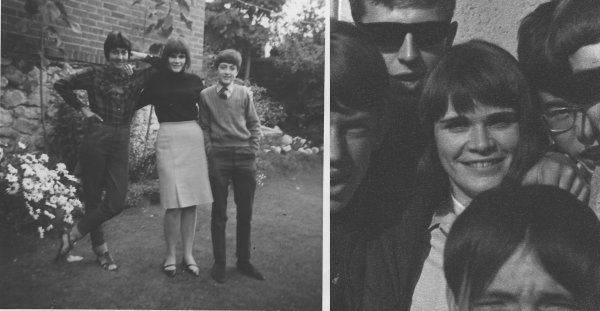 On visiting Stuttgart we were shown the house where General Erwin Rommel, the Desert Fox, had been arrested and put into an ambulance, then made to take poison so that he was dead on arrival at the hospital. It was a privilege for my wife and me to host and befriend Gabriele, a beautiful dark haired niece of the German War hero, and that was the sort of personal experience which gave a true dimension to our knowledge of postwar Europe.
In 1961 the tensions between East and West Germany were such that East Germany built the Berlin Wall, a device intended to stem the flood of Germans from East to West. We were given the background to the problems whilst visiting Esslingen, and the energetic and industrious Germans in the West were welcoming immigrants to overcome chronic labour shortages. At Stuttgart Railway Station there had to be careful immigration control to deal with immigrants from Eastern Europe and even further afield.
The Berlin Wall continued to feature in the news so persistently that my wife and I decided to see it for ourselves. We took our teenage son to Berlin in 1968, and climbed up to a viewing platform. Only by being there can one fully understand the effect of that monstrosity. Over the wall, beyond the tank traps and the barbed wire, huge deserted blocks of old buildings with bare blind windows and trees growing out of their roof parapets contrasted starkly with the smart, even brash modernity of West Berlin.
The Wall is part of history now; but many young lives were lost because of it. Even in 1968 there were many heartbreaking memorials to those who had died because they wanted freedom. In 1989, once the wall was breached, the young people of Berlin demonstrated that all they wanted was freedom of choice. Today bits of the wall are being sold as souvenirs. Doubtless those bits will increase in value over the years. The obscenity of it appals me. How many bits have been splashed with the blood of innocents?
Whilst in Berlin we visited the stadium where Hitler staged the 1936 Olympics. The vast, forbidding grey buildings and the huge central area - used by Hitler for rallies of his Hitler Youth - were silent as we looked around, but they evoked memories of those prewar days, especially the day a black runner took a Gold medal, and Hitler nearly went mad.
Berlin was of course entirely surrounded by East Germany, and in the 1960s the strain of that containment was tangible. Russian and Allied troops faced each other at the various border points, and Russian guards of honour paraded in front of the War Memorial in the city. West Germany could not possibly use Berlin as its capital; it had to be in Bonn. Life was much easier in West Germany itself, and in Baden-Wôrttemberg in the southwest of the country there was little evidence of the strain of living under threat from the Warsaw Pact countries of Eastern Europe. Life in old Esslingen seemed very sweet.
As the Youth Exchange grew, we also came to know Vienne, a proud and ancient town on the Rhone near Lyon, - which seemed to have suffered little at the hands of the Germans, - and Udine, the town in northern Italy, a Friulian town situated uncomfortably close to Yugoslavia. The two towns are rich in history, in the arts, and in warmth. We could not say the same for Schiedam, where fear and resentment were still evident, nor for Norrkóping, which seemed to regard the friendship links as a bit of a bore. Our Swedish partners in the Exchange were dull and remote in comparison with the others.
Of course the youngsters enjoyed themselves, putting the older generation to shame as they showed off their lingual skills; but for me at any rate, there was an opportunity to develop an understanding of our European partners, and we basked in mutual friendship. To our great surprise, we discovered that Neath was the most popular Youth Exchange town. The Welsh people were natural hosts.
A greater understanding grew in Neath also, as teenagers from the various towns came to live in with our families. There was one unforgettable incident concerning one of our leaders. He was a member of my staff, and I asked him to take his wife and a group of Neath youngsters to Esslingen. He demurred, explaining that he had lost a brother in the war. However, he went. When he returned, he thanked the Committee for sending him - the exchange had changed his attitude to the Germans, and had helped to heal the wounds of his loss.
As mutual respect and understanding built up amongst the leaders and organisers, visits were made to their homes, enabling us to find out what they were really like. We met wives and children, played and chatted and looked at family snaps, and there was no attempt to hide the photographs of the men in uniform.
One warm and friendly character who played a big part in the development of understanding and confidence was a burly, cheerful businessman called Herbert Stiefelmayer. He was a member of Esslingen City Council, and Chairman of the Youth Organisation. When I visited his home I noticed the war photographs and memorabilia; he must have been a Wehrmacht officer. He was a bachelor, and a keen youth worker.
In 1964 Herr Stiefelmayer gave me a book, endorsed charmingly as a souvenir of our friendship. That book today seems to me to encapsulate all the emotion, the regret, the sorrow and the hopes which grew as we went about our humble work of Youth Exchange.
It is not a textbook, nor a tract. It is a book of beautifully executed photographs. Its title is "Kinder Aus Aller Welt" - Children All Over The World. The photographs are not of kids in national costume, dressed up for show. In the main, because they are of children from Third World countries as well as the USA, Australia and Europe, they show children in rags, babies being carried by their working mothers, urchins asleep on the pavement, naked children, happy children. They show children in need.
The book was the gift of a well-to-do German, one whose countrymen had allowed the Nazi regime to organise a programme for the extermination of all Jews - men, women and children. To me, the gift was an act of contrition.
Youth Exchange has become an established part of goodwill links now in towns throughout Britain, and contacts have been widened to include such things as exchange visits by choirs and junior football teams. Flags fly proudly outside many Town Halls, and welcome signs at district boundaries advertise the links.
It is all very different from post-1918, when reparations and artificial controls laid the foundations for another war. It is all very different because the children have had a chance to see for themselves, to mix with children of other lands, whereas - if my personal experience was anything to go by - my generation of children of war knew nothing about German, or French, or Italian children. It is all so different because communications have caused the world to shrink, and we can see the news on television as it happens.
The exposure of events with the speed of light has evoked responses of compassion and generosity which were impossible in my youth. Disasters are recorded around the world, and they give rise to great surges of financial and practical aid, airlifts of emergency supplies and flights of skilled personnel to the disaster areas.
The major disasters - earthquakes, floods, fires, storms, - all seem to have one feature in common; they involve children. The wars in the Middle East and Far east, the struggles in Africa, the famines, involve children. There is nothing more sickening to me than to see children carrying weapons of war, obviously provided by adults. Hitler relied on his Hitler Youth to back up his armed forces, and they were indoctrinated with an unreasoning hatred of the Jews. Children went to the concentration camps and the gas chambers. The vast majority of the Vietnam refugees were children.
Recent years have witnessed the rout of Communism in 1989, the exposure of atrocities and the breaking down of political barriers in 1990. That has been achieved in the main by children of the Second World War, and by their children. As we watched and read the news, and as we took time to remember on the Anniversaries of The Battle of Britain and of the Dunkirk miracle of evacuation, we were reminded that the victims and the lucky ones included a large proportion of mere teenagers, kids who had had no say in the waging of the War.
Again and again historians have recorded the rise and fall of empires, and today there are other threats to civilisation which endanger the world population. Society has become victim of the worldwide spread of drug trafficking, to the extent that children in school, and even babes in arms, are found to be addicts. Solvent abuse is a product of our advanced technology, and children are their own victims. Perhaps the most horrific evil to emerge in recent years has been the incurable Aids virus, which is affecting unborn children and adding further terror for victims of sexual abuse. International terrorism is indiscriminate in its slaughter, and seems to be an intractable problem.
The rulers of today, and the young people who will follow them, have enough problems without War or dreams of Empire. They have the task of saving civilisation against itself.