| Contents | Foreword | 1 | 2 | 3 | Voyage to Penang and a New Life |
5 | 6 | 7 | 8 | 9 | 10 | 11 | 12 | 13 | 14 | 15 | 16 | 17 | 18 | 19 |
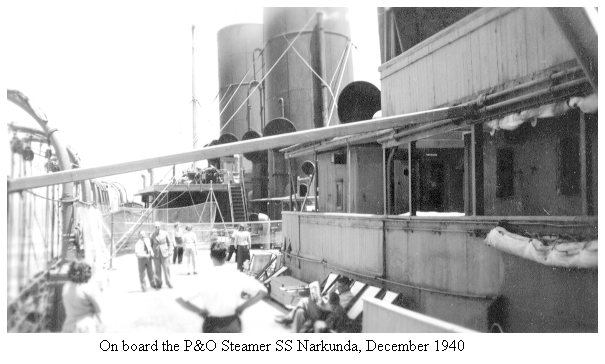
The ship became filled to capacity. As I watched the baggage being swung in cradles from the wharf to the forward hold, the labels showed Bombay, Singapore and Hong Kong. The passengers included rubber planters and Government officials returning from leave, and wives and children going back to join their husbands and fathers in Malaya or India. The smokeroom was taken over by sixty Marines, whilst the Second Class section accommodated Dutch youths who were going to Java to join the Dutch Navy, and a few Sergeant Pilots of the RAF.
Loading continued all day. At night the German bombers came over. We were not allowed off the ship, and the weather was bad, so we stayed in the lounge whilst the anti-aircraft guns rattled overhead and the pulsating roar of the bombers filled the air. No bombs seemed to drop near to our ship, and by bedtime all was quiet.
The Narkunda did not sail until the third day, when she was pulled out by tugs to the harbour mouth to take up position in the estuary. We saw a French Hospital ship and an assortment of cargo vessels of many nationalities, with destroyers moving around assembling the convoy. Once in position we anchored and waited, from two o'clock until dusk. At last the Narkunda sailed alone, leaving the convoy behind.
Not quite alone. For the first twenty-four hours the ship was visited by Sunderlands and Spitfires, until at last we were on the high seas, sailing northwest. The November weather became colder and the seas worsened as we headed for mid-Atlantic.
The feeling of loneliness in a crowd of strangers was oppressive. Bad weather kept us inside for the most part. Miserable groups filled the lounge, reading, knitting, smoking in the stifling atmosphere, and playing Bridge. Apprehension mingled with boredom and tobacco smoke - what on earth was I doing there?
Then at last came a little relief, as piano music filled the air. The young Director of Music for Singapore, a man called Williams, went to the grand piano and played a waltz. A ballad followed. Passengers murmured approval, a few applauded, and the ice thawed a little. The recitals became a popular evening feature.
After dinner one evening a fellow diner suggested a walk on deck, as the weather had improved. As we paused to let our eyes become accustomed to the darkness, he asked me if this was my first trip. It was probably obvious to everyone that it was. We began to pace the deck, and talked about our destinations and what lay ahead. He was a Scot named Young, and he filled me in with a mass of advice and information on customs, ways of living, social life, dress - many things still to be discovered. The walk on deck became a regular feature of life on board, and Young introduced me to other passengers as the long days went by.
As the ship headed south down mid-Atlantic the weather improved, and we were able to play deck games. Radio silence isolated us from news of the War, so that we were in a little world of our own. There was the daily log to read, and the sweep to guess the mileage covered, and a strange game at night called Housey Housey, which seemed to me too silly to bother with. Years later that game emerged in converted cinemas with the name of Bingo.
On the eleventh day a small cargo vessel was seen riding high in the water, flashing signals to us. We were told that the captain of the St. Marie II had been dangerously ill for three days, with a temperature of 104, and that the cargo ship had no doctor aboard.
The Narkunda hove to and lowered a boat in the heavy sea. The boat was carried away on the first attempt, and we had to chase after it. Then the crew of the cargo boat lowered the sick man on a stretcher into their own lifeboat, and pulled across to our port side. The blanket which covered him was removed, and he lay in his pyjamas on the stretcher, exposed to the winter sea air, panting for breath, his face the ghastly pallor of death. He was strapped into a canvas bag and hauled aboard. His few belongings followed him to the ship's deck. The crew pulled away.
The captain of the St. Marie II died overnight, and was buried at sea the following morning. Fitting, I suppose, for a mariner in Wartime, when Britain's lifelines were in peril.
Flying fish were seen for the first time one Sunday in November. They were leaping from the water and gliding from crest to crest of the light sea swell, tipping the brine with tiny flecks of spray and flying for incredible distances like gleaming swallows.
Two days later the shores of Africa came into view, at first a dim grey line in the early morning light, then changing to a palm-clad outline as the ship neared the coast. We steamed into the harbour of Freetown, Sierra Leone, about 8º north of the Equator. The ship steamed gently past slender canoes whose occupants waved spear-shaped paddles in salute, and anchored opposite the oil tanks. One side of the wide natural harbour was flat and swampy, with palms and low vegetation. The other shore was fringed with hills, Government buildings and quarters lining the slopes, and a lighthouse on the headland.
Now one of the bits of official advice given to me related to Malaria. The effect of Malaria was known to me, because a Colne cricketer was a sufferer. My personal effects therefore contained a bottle of quinine tablets. Although we were not allowed to leave the ship, and there was a considerable distance between us and the swamps, caution overcame valour, and I took a tablet. Mosquitoes were not going to get me so early in my adventure abroad. That is how green I was.
SS Narkunda had barely anchored when dozens of canoes came alongside, the West Africans grabbing the lines and any available projections to hold their light craft against the current. Their clothes were a strange mixture of battered topees, Balaclava helmets, old peaked sailors' hats, soft felts, and even one blitzed silk topper graced bullet heads. Shirts of many hues but rather worse for wear topped ancient khaki shorts tied with old rope. A knockabout Pantomime cast, anxious to relieve the tedium and tension for the ship's passengers.
Our canoe-borne visitors could be grouped into three categories: the salesmen, the divers and the entertainers. The salesmen threw ropes to the main deck, and selling began. The hilarious trading was mainly barter, old clothes passing down the rope in a basket, examined critically, then exchanged for a dozen oranges or bananas. Handwoven baskets were sold for up to five shillings. Monkeys were offered also, but there were no takers that day.
The divers were single occupants of small canoes, and they wore only loincloths. They called out for "English pennies" or "Liverpool sixpence", their huge eyes scanning the decks for signs of coins being thrown overboard. When a coin was thrown, the diver fell into the water after it and reappeared a moment later with the coin between his teeth. One wag called out "May the Lord bless your soul" as he climbed skilfully back into his craft.
The entertainers regaled us with song, popular numbers being "The Lambeth Walk" and "Run, Rabbit, Run", which took on a new dimension when sung negro-fashion by deep rich voices, the performers clapping their hands and slapping their thighs and laughing with wicked gurgles and flashing teeth.
We steamed out at 1 pm the next day with the ship refuelled with oil, and the mainmasts and funnels of two wrecks rose grimly above the surface of the shallow waters near the lighthouse as we passed through the boom.
SS Narkunda crossed the Equator on Friday morning, and just one week later we awoke to see Table Mountain and the Lion Peaks of Capetown rising from the morning mists. A thin wispy layer of silvery cloud lay as a tablecloth over the mountain, its edges falling gracefully down the crevices like a lace fringe. We were glad the Suez Canal was closed, otherwise we would have missed the Cape.
The ship was pushed into Capetown dock by tugs, and we went ashore, terra firma after twenty five days at sea. We had caught early summer, and the sun was almost vertical overhead, but not oppressive. We wandered about the streets, enjoying the sights and pausing to buy souvenirs. The Flower Market was ablaze with colour and buzzing with activity, the negro sellers sitting on the footway alongside the Post Office, occupying a whole street. The busy Fruit Market filled the air with the aroma of peaches, plums, bananas, pineapples and strawberries.
A party was made up to visit the cinema, and we walked through the fully lighted streets among the neon signs and floodlamps - a change from the blackout at home. We found our way to the Del Monico, a famous tourist attraction. The interior was a faithful reproduction of a Spanish courtyard, with a paved floor, and soft lanterns hanging from stucco walls. Balconies overlooked the central area, and a blue sky with stars and vaporous night clouds added realism to the tiled roofs and tiny windows.
Next day we ascended Table Mountain, first by bus and then by cable railway. The view from the swinging cage as it climbed steeply to a height of four thousand feet was breathtaking. Table Bay spread out as a map, and the city and suburbs lay in a motley pattern beneath us. The plains rolled out to distant foothills, to lose themselves in misty blue. At the mountain top we scrambled over the rocks to drink in the air and gape at the view. A silver plane flew past, and it was actually below us, a toy thing in the vastness, a thousand feet beneath.
We returned to the Narkunda, and she steamed out of Capetown in the early evening as we revelled in the memory of the short stay there.
The days that followed were hot and windless, and the nights a trial because of the closed portholes and baffled entrances. The full moon allowed us to dance on deck, but the air was breathless, and I was bathed in perspiration. Due to overcrowding, the ship's laundry could not cope, and my own efforts at washing clothes were ineffectual. It was impossible to keep cool.
On 15 December 1940 the passengers woke up to find that the ship had already tied up at Mombasa, Kenya. We were given a few hours' freedom from the overcrowded vessel, and we went ashore at once.
In prewar days Mombasa was normally a small quiet place, but when we arrived it was the scene of considerable military activity. Five troopships came in that day, and the docks were full of army vehicles, equipment and men. After a short walk to the post office and shops we returned to the ship and watched the activity from the decks before we sailed in the early evening.
A few days later the news explained the cause of the troop movements at Mombasa. The army had gone via Kenya into Somaliland, and shortly afterwards was the successful British campaign in Abyssinia.
Christmas drew nearer, and dawn revealed the distant coastline of India. This unfolding of a scene is one of the advantages of travelling by sea. Air travel today removes the slow arrival of a misted horizon and the gradual disclosure of unknown shores. We relished the approach to the sub-continent that morning, until the ship berthed at Bombay. I eagerly bought rupees aboard and went ashore.
The first impression of Bombay was something of a cultural shock. As I walked the mile from dockside to the city I was pestered by beggars and hawkers and roadside entertainers. Halt, lame and blind slept on the footpaths, urchin beggars were everywhere, and lewd postcards were offered by dirty Indians. Every few yards I was invited to hire a gharry drawn by an ancient and undernourished horse. The smell was awful, and dust was everywhere. The thought of spending four days celebrating Christmas in Bombay depressed me and made me homesick.
Hockey was being played on a beautiful grass pitch in the city. There was a public recreation ground called the Oval, and the Asiatic city dwellers were enjoying their Sunday afternoon in their best clothes. For my part the sultry heat and dust were too much, especially as I had no tropical clothes, so I returned to the ship.
The following morning was spent sightseeing. A light cruiser Leander was being scraped and painted in dry dock. A guide pointed out the principal sights and buildings, and we went on to Victoria Gardens, with birds and animals to add variety. We visited a cinema in the evening. All rather touristic, not a bit like Christmas.
Christmas Eve was a day for shopping, and a small party decided to absorb the local colour by visiting the Asiatic quarter. We walked the dusty streets, looking in at bazaars and eating houses, our lungs filling with the smells of dung and incense and our throats and eyes assailed by the pervasive dust. Pavements were dotted by large red patches where Indians had spat out the juice of their betel-nut chews.
We took a taxi to the European shops, thankful for the relief, and saw the toys and chocolates, cloth and hardware - from England. The sight of these things merely fed my homesickness. Get back to the ship, let's get away - that was our common reaction on that Christmas Eve.
Christmas Day 1940 was celebrated on board, the saloon having been decorated with a display of all the Allied flags, and the kitchen staff went out of their way to prepare a rather special meal. But Christmas needs family, and there was no family feeling there.
Whilst the passengers were passing time as I have described, the ship was being cleared of its sand ballast, loaded with cotton and spirits, and reorganised in its accommodation. The Marines had disembarked, and we said goodbye to many of the civilian passengers too. Nobody was sorry to leave Bombay.
The next port of call was Colombo, Ceylon. There the ship anchored in the harbour and we went ashore in the tender.
Colombo was very different from Bombay. Neat clean streets and pleasant shops greeted us, and we bargained for moonstone necklaces and hammered brassware. Two of us took rickshaws to Victoria Park and admired the trees of cinnamon, rubber, eucalyptus, bay, papaya, breadfruit and other exotic fruits. We cooled off in the Galle Face Hotel with a drink and a swim in the freshwater pool, then walked back along the smart promenade to the jetty. Brilliant blue flashes in the evening sky warned us of an impending storm, and we were back on board as rain fell.
The ship sailed next day, and ran into thick fog in open sea. The night sky was leaden and the air heavy, and soon I was experiencing my first tropical storm. Lightning flashes hit the decks and sparkled the water, which poured in sheets from the deckheads, and rolling crashes of thunder combined with the noise of sheets of rain beating on the sea. Visibility was nil, and the foghorn was sounded. To our consternation there was a reply at very close range, and the engines were shut off. For a breathless half hour the vessel drifted in the storm, with no visibility ahead, the foghorn sounding until the replies grew fainter. As the ship moved carefully ahead a strong wind sprang up and the storm receded.
New Year's Eve was a greater success than Christmas had been, probably because we were near journey's end. 1940 had not been a good year anyway. The first two hours of my 1941 were spent in the cabin of one of the ship's engineers, drinking toasts and scoffing nuts, cake and chocolates. During the voyage I had come to appreciate the calibre of the officers, and it was a privilege to share their time off between watches. For me they represented the real world at sea, compared with that of the pampered passengers. There was a special significance to the New Year toasts that night; we learned that this was to be the last run of SS Narkunda as a passenger liner, and that she would become a troopship on her next run from home. Many of the engineers would leave her at Singapore and join the Ile de France, which had put in there when France had capitulated. The French ship had been taken over by the Allies.
On New Year's night some of us were privileged to entertain a number of young Naval Ratings who were going to Singapore. We had an impromptu concert in the second class saloon. I have often wondered what happened to those boys, who had left their homes for the first time to go to the Far East.
Although my ticket was to Singapore, later instructions told me that I was posted to Penang, our next port of call. We docked there on 3 January 1941. I watched my baggage ashore, then struggled to make myself understood by the Malay Customs Officer. No doubt my strong Lancashire accent was foreign to him, and I had started to study Malay only on board, never having heard it spoken. He gave up at last, and my baggage was chalked.
The Settlement Engineer's office was near to the wharf, and there I met an Assistant Engineer named Grehan, who took me for lunch after dumping my baggage.
Grehan was at that time living in a flat, part of a block run by the Government for bachelors. The Elysee Cabaret was across the road, and the E and O Hotel was just around the corner. As we ate lunch, made and served by Grehan's cook-boy, Grehan talked and I listened. First he said that my tour would be for four years, not three. The Government always extended the first tour, he said. Then he spoke of the job and my status. He referred drily, perhaps cynically, to 'PWR' his abbreviation for 'Prestige of the White Races' - and expressed the view that there was little of that left. This puzzled me, on my first day. Now I think I know what he was talking about.
My English lightweight clothes were uncomfortably heavy in the heat of Penang, and I had no tropical clothes except a bespoke white mess jacket known as a 'bum freezer' which a Bombay tailor had made in twenty four hours whilst we were in port there. To this day I cannot understand why I didn't think to buy shorts and shirts as well. I was hot and weary, and Grehan suggested that I should change. He took me to the nearby Rest House, where temporary accommodation had been booked.
The bed in my room intrigued me. The mattress was covered by a single sheet, and a thin cotton blanket lay folded at the foot. A cylinder of mosquito netting was hitched up, there were two pillows at the head. Down the centre of the bed lay a long sausage-like bolster about nine inches in diameter. The lady of the house, amused at my ignorance, explained that one got onto and not into the bed. The bolster was known as a Dutch Wife, and the idea was to twist one's arms and legs around it so that air was free to circulate and keep the sleeper cool. The thing was repulsive to me, and I never used it. Why a Dutch Wife?
My job as an Assistant Engineer in the Colonial Service had begun. It was in every sense a journey into the unknown.
| Contents | Foreword | 1 | 2 | 3 | Voyage to Penang and a New Life | 5 | 6 | 7 | 8 | 9 | 10 | 11 | 12 | 13 | 14 | 15 | 16 | 17 | 18 | 19 |