| Contents | Foreword | 1 | 2 | 3 | 4 | Life on Penang Island |
6 | 7 | 8 | 9 | 10 | 11 | 12 | 13 | 14 | 15 | 16 | 17 | 18 | 19 |
Penang Island had everything. The town - Georgetown - had shops and cinemas and two cabarets. There was a Turf Club and Sports Club, and a swimming pool north of the town. The duties of an Assistant Engineer included the supervision of the forty-six miles long road running round the island, the inner roads, Glugor Seaplane base, Bayan Lepas Aerodrome, the holiday retreat of Penang Hill, and all government buildings and civil engineering works on the island. A wide and varied experience prospect for a young civil engineer.
At the end of the first week, Saturday night, Grehan and a friend called Wright took me to the Elysee Cabaret. Admission was free, and we were ushered to a vacant table in the large, softly-lit dance hall. A Filipino band was playing a waltz. There were a few white women present, but mostly Chinese, Malay and Eurasian girls were dancing with Asiatic and European partners. Wright smiled at me and asked what I thought of them. They were Taxi girls. Wright called a boy and bought a book of tickets. The dance ended, and the girls walked back to their tables around the dance floor. The Chinese wore long skintight dresses, split to knee height, and the Malays and Eurasians wore European style gowns. All of them walked like professional models.
My companions jumped up to choose partners when the next dance started, and I thought perhaps it might be interesting to have a go myself. The dance did not last long, and Wright told me to be quick if I wanted a partner next time. In spite of this advice I was almost too late to get a partner. There was a tallish Chinese girl however, and as I approached she stood up and laid her small purse on the table.
She was warm. As our hands met I could feel the moisture on her fingers. Her tight fitting dress was soaked at the back. She reeked of perspiration. As we danced in silence I became aware of the odour of cheap perfume and garlic. Dancing in such circumstances must be an acquired taste, I decided.
The dance ended after only a short time, and the girl turned and walked back to her place without acknowledging my thanks. Back at my table, I realised that I had forgotten to give the taxi girl a ticket. My friends pointed out a Chinese sitting at a desk, scrutinising the dancers and making entries in a book. My partner would get into trouble and lose her commission if she had not collected her ticket. I decided to make amends when the next dance began.
The next dance was a slow foxtrot, and I went to my partner. It was a good slow foxtrot, and I probably was less ill at ease than before; she was a good dancer; this wasn't bad at all. Then she laid her head on my shoulder and pulled me tighter to her.
It is an uncomfortable experience for a man to become excited when dancing, especially something like a slow foxtrot. The girl's slim thighs were against mine, and without the dress she would probably be naked. After each open step she melted back into my arms. Not a word was spoken; none was needed. It was a wonderful demonstration of body language.
The music ceased, I pressed two tickets into the girl's hot hand, and she left me without a glance. At least she could have given me a glance. Back at my table I agreed readily when Grehan and Wright suggested that we try the other cabaret, the Wembley.
The Wembley Cabaret had a better band and lovely girls, and my two companions took some tickets. I had had enough excitement for one night, and was glad when the cabaret closed and we went home.
* * * * * * * * * * * * * * *
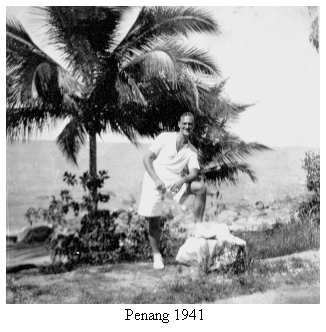
As I got into the daily work routine, and as my Malay lessons progressed under the careful and courteous tutelage of a munshi, a schoolmaster named Isahak, things like the wage payments had to be learned. Wages were paid in cash, names as long as my arm being called out by the gang supervisor, and we had Sikh Police escorts. If the wage payments didn't tally with the cash issue, the Engineer had to make up any deficiency himself. Excess cash went back into the coffers. There seemed something a bit unfair about that.
Three weeks after my arrival in Penang the Chief took me on an inspection of the lighthouses on the Island. The easiest way to visit them was by launch, and the inspection provided an excuse for a good day out. At eight o'clock one Sunday morning a small party boarded a craft hired for the day. It was a large houseboat with four cabins, a deck awning and a small saloon. Food and drink, cameras and swimming gear ensured a good day out combining work with pleasure.
We coasted round the Island, stopping at each inspection point and trudging up the steep headland slopes to each lighthouse. The tour of inspection was over by noon, and the rest of the day was for fun. Tiffin, then a drowsy hour in the shade, a swim in the warm sea, then a leisurely return to the landing stage at Glugor as darkness fell - about seven o'clock. A hard day's work in Paradise.
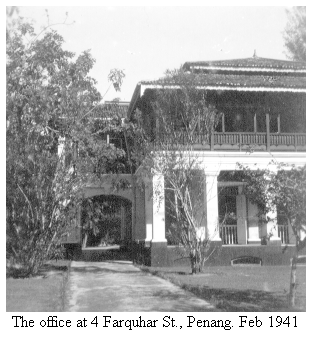
Chinese New Year followed the Island jaunt, and a fellow boarder at the Guest House took me to meet a business acquaintance named Wei Fung Cheong Tim, a wealthy and educated shopkeeper. At five o'clock we arrived at the large shop and met the manager, Mr. Lee. A large circular table had been set in the middle of the shop floor. Eight places were set with ivory chopsticks, two small deep bowls each, and a moist napkin. Apart from my friend Alec and myself, all the diners were Chinese.
We took our places, and I looked at my chopsticks with misgiving. Mr. Lee laughed, and showed me the art of handling them. One stick is held firm and the other moves freely. My practice with wooden toothpicks broke the ice as the Chinese laughed good-naturedly at my comic act.
Shark's fin soup was the first course, with spoons. At least there was some sustenance before the big test. The thick and glutinous delicacy had a wonderful flavour, and it was devoured with great gurgles of intake and smacking of lips. This was a little unnerving, but it soon became obvious that these highly respectable diners were unashamedly expressing their appreciation to the host. We polished off the soup noisily and sighed with pleasure as it finished.
Next was a mould of dried oysters with seaweed garnish. Try them sometime - with chopsticks.
Many courses followed, all served in large bowls which were left on the table for diners to help themselves. Fried prawns with sliced cucumber, a whole filletted duck covered with finely chopped vegetables, a large complete fish - head and tail intact and fried in tomato sauce - chopped chicken and ham, and Shanghai sausage, which is a mixture of all types of cooked meats - fowl and liver and beef - cut into thin strips.
The rice came last in a large bowl. So well prepared was the boiled rice that it could be picked up grain by grain.
Whilst all the food was being brought in, large tumblers were set at each place and filled with a colourless liquid which I thought was water. It was neat gin. Somehow it went extremely well with the food.
China tea, unsweetened and without milk, ended the meal as a sort of ritual. Alec and I made our way homewards. But no, the night was young, and this was a holiday. We visited a pleasure garden - an Oriental fairground - and when we had had enough of the noise and bright lights we went to the swimming baths for a dip. Amazingly we were in very good shape as we eventually reached the Guest House.
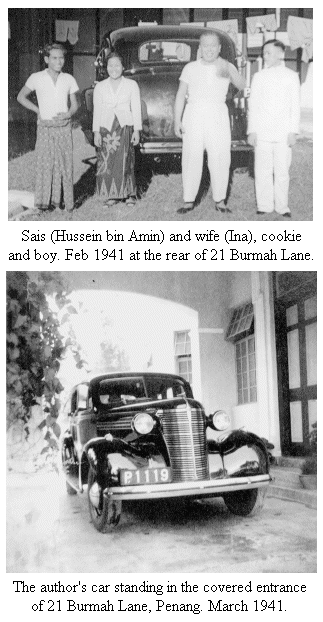
My Malay munshi worked me hard for three evenings a week, and within a month I was able to make myself understood and to understand the boys and the shopkeepers, as well as the Chinese contractors and mandores or foremen. I had also bought a car, a secondhand Chevrolet which reminded me of my father's Armstrong Siddeley of years ago. I was advised to engage a sais until I had become accustomed to the Island. One day a small Javanese marched into the office, saluted with a "Tabek, Tuan", and handed me his credential documents. He was Hussein bin Amin, aged twenty four, and after a few minutes he was engaged. A few days later his wife arrived. She was a beautiful girl of eighteen, petite and shapely, with a flawless complexion. Dorothy Lamour had nothing on this genuine Malay beauty. This was the real thing.
Penang was virtually free from the menacing mosquito - nobody used their mosquito nets - and a breeze called the Sumatra sprang up from time to time to fan the heat away and bring cooling rain. Badminton outdoors, tennis, swimming, and friendly Europeans - Penang was a place in a million for a young man far from home.
There seemed no end to the new experiences to enrich life. On Monday 10 February there was another holiday, because it was the Hindu Feast of Thai Pusam. That is the day when Hindus pay homage to their gods by performing the most incredible acts of sacrifice and endurance. A great procession the previous night bore the golden god from the town Temple to one in Waterfall Road. The ceremony started on the Monday.
A crowd of Tamils collected at the Temple, and priests presided over the ritual of the knives. Tiny knives and spikes were heated to a dull red, then were pushed through the lips and cheeks of the volunteers. A bed of glowing coals burned fiercely on the Temple floor, and the worshippers ran barefoot across the fire to the accompaniment of ritual music.
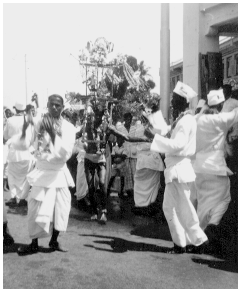
Heavy burdens - about fifty pounds each in weight - were then fixed over the heads of the central figures in the ceremony. The burdens were carved models of temples or gods, made of wood and decorated in silver. Iron struts rested on the shoulders, and dozens of thin wire guy lines held the burdens in position, their ends fashioned into wicked looking hooks which were dug into the flesh of the bearer's chest and back. As each burden was fixed, the performer was dusted with lime, and left the Temple with a priest and followers. He then began to dance and sway erratically and unsteadily to the accompaniment of chanting and hand clapping, jogging the burden up and down, spinning round, his face and trunk streaming with perspiration, his bare feet stirring the dust of the street. About fifty of these men were performing, and they had to go for four or five miles to the Waterfall Road Temple where the Golden God awaited them.
The performer was not allowed to rest. He had to stay on his feet; nobody must give him support. At times an exhausted Tamil would stop, swaying perilously, with the priest chanting madly at him, and his family and friends shouting words words of encouragement.
We followed the procession to the second Temple, where the knives would be removed. This Temple was on top of a hill, and the suffering performer had to climb two or three hundred steep steps. As we climbed the slope leading to the steps we saw a crowd round one of the Tamil bearers, gathered near a small shrine. The man was almost unable to stand. His eyes were closed, and his burden swayed perilously above his head. Sweat and saliva streaked his face. His lips were skewered together by a thin brass knife. The lime on his torso was streaked with perspiration which poured down relentlously. The priest was shouting and chanting, dancers were in a mad fervour, and women were throwing lime dust on the suffering face and chest.
Failure would mean disgrace. The crisis before the shrine lasted fully five minutes. Then the Tamil's eyes opened slowly, and he turned unsteadily towards the cruel steps. A great cheer filled the air as he tottered and faltered step by step to the end of his journey.
The Temple ceremony was brief and simple. The knives and pins and hooks were removed with care, the wounds dusted with lime. Then the performers were given coconut milk to annoint themselves. No blood flowed, because the red hot steel had cauterized the holes, and the lime dust kept them dry and clean. The absence of blood was significant to the worshippers.
The strength of the faith, and the fortitude of the performers, were awe-inspiring, and the almost hypnotic atmosphere was eerie.
We descended the steps, stopping at times to give a few cents to lame and blind beggars, then we entered the shrine where the Golden God was set in state. There a priest was praying and a Tamil stood guard. Worshippers approached the shrine with downcast eyes and hands clasped before their lips, backs bent in submission. As they reached the arch to look in at the God, they dropped money into an earthenware jar. Silent words formed on their lips. Then they passed to the courtyard where the poor were being fed. They squatted on the paved yard, with part of a banana leaf before them. Rice was dished out from a wooden bucket, followed by a yellow curry. Outside the courtyard, the throng were washing their feet and faces in the stream, and children bathed naked in the yellow water. There was a festival atmosphere to contrast with that inside the Temple. In the wood behind the Temple were entertainers, salesmen and more beggars, and Tamil families sat around. A peaceful climax to a ceremony of intense devotion and personal suffering.
Next day my munshi Isahak took me to the Malay Borea, a festival of competitions which started at eight thirty each night and went on until five o'clock next morning. We sat amongst Malays and Chinese in the open-air theatre, watching amateur groups playing guitars and ukuleles, dancing and singing, performing in sketches. My teacher used the latter to improve my knowledge of the language. One troupe sang 'The Siegfried Line' in Malay, and it reminded me of the song's popularity in 1939 - and of its disappearance when France collapsed. Another topical item was an act when the words 'pisang goreng' - which is Malay for fried banana - was worked into a joke about Hitler's Hermann Goering. Not very funny when you knew what had happened in Europe.
The cost of the accommodation at the Guest House was rather high for a young man at the bottom of the salary scale, and when my fellow-boarder Alec suggested moving into a Mess, I agreed readily. Alec knew of a house in Burmah Lane occupied by three men - and a Siamese girl. One of the three had brought her there, and the other two had asked him to leave. There would then be room for two men.
We inspected the Mess, a large Chinese-owned house with cream walls and red tiled roof, standing in spacious but ill-kept grounds, its kitchen and servants' quarters connected at the rear by a covered way. The furniture was rotan; a large single fan swirled silently in the lounge, and we met the two messmates over whisky-sodas. We discussed the financial details, and then the cook was summoned.
He was a huge, fat smiling Chinese. His belly quivered as he shuffled in. His bland smile contrasted with small dark almond eyes, wicked roguish eyes. He was middle aged, but lithe and unwrinkled and ageless.
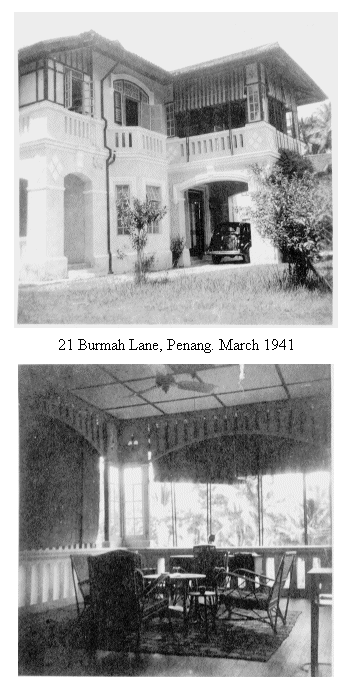
We moved in to Burmah Lane a week later. Furniture had to be ordered, and bedding and other items we had not had to obtain when boarding at the Guest House. A Chinese cabinet maker made a bedroom suite to my own design within a fortnight, providing temporary furniture meanwhile.
Things were taking shape, and I was gaining confidence with the cook and the Mess routine, when Alec and the other two had to leave for Camp with the Straits Setllement Volunteers. I was left in charge of the house.
The experience of settling the kira - the household accounts - was nerve-wracking. The cook had the items listed in a small notebook in Romanized Malay. Ten cents per day for a rickshaw, varying amounts for wood, and items for meat, eggs, vegetables and seaweed. The daily bill was always about three dollars. When Alec called a week later and I told him of my misgivings, he laughed and told me not to worry. If I caught the cook out one way, he'd catch me another. If he couldn't make a dollar or two for himself through the kira, he'd ask for more gaji - more pay. Just part of the white man's burden.
On the sixth of March 1941 Penang had its first trial blackout. It was really impossible to black out the Mess, with its open walls and airy rooms. We just had to dim the lights. At the office the orders came to prepare designs for Air Raid Shelters and to organise Rescue and Demolition parties for the Department. I had come halfway round the world, only to do the things I'd been doing at home.
On the seventh of March a letter arrived at the office for me. It was an instruction from Head Office in Singapore. No words were wasted; I was to report to the Senior Executive Engineer, Kuala Kangsar, in the State of Perak, on the thirteenth of March. Nine weeks after landing at Penang I was to cross to the mainland and start all over again.
| Contents | Foreword | 1 | 2 | 3 | 4 | Life on Penang Island | 6 | 7 | 8 | 9 | 10 | 11 | 12 | 13 | 14 | 15 | 16 | 17 | 18 | 19 |